Table of Contents
- 1. Home Equity Lines of Credit (HELOC) for Kitchen Remodels
- 2. Cash-Out Refinancing to Fund Your Kitchen Project
- 3. Personal Loans as a Quick Financing Alternative
- 4. Contractor Payment Plans and In-House Financing Programs
- 5. FHA Title I Property Improvement Loans
- 6. Design-Build Financing Through Your Remodeling Contractor
- 7. Savings and Phased Remodeling Approaches
- Frequently Asked Questions (FAQ)
1. Home Equity Lines of Credit (HELOC) for Kitchen Remodels
A kitchen remodel is one of the most rewarding home improvements you can make. It transforms how you cook, gather as a family, and experience your home daily. Yet the upfront cost often stops homeowners from moving forward. The good news? Multiple financing paths exist for Fairfax County and Northern Virginia residents, each with distinct advantages depending on your timeline, credit profile, and financial situation.
We’ve helped dozens of homeowners in Annandale, Arlington, McLean, and throughout the region tackle kitchen renovations through different financing strategies. Understanding your options puts you in control and helps you choose the method that fits your goals and budget.
A HELOC lets you borrow against your home’s equity, typically at a lower interest rate than unsecured loans. You draw funds as needed during the draw period (usually 5-10 years), then repay principal and interest over a longer timeline.
HELOCs work especially well for kitchen projects because you can access money in phases. Need funds for design and permits upfront? Draw early. Ready to pay for materials and labor? Draw again when those invoices come due. This flexibility prevents you from borrowing more than necessary and paying interest on idle cash.
The catch: your home serves as collateral, and rates are variable. If interest rates climb, your monthly payments rise accordingly. Northern Virginia’s competitive lending market means you’ll find numerous HELOC products, but always compare APR, draw-period length, and closing costs across at least three lenders.
What to do next: Request HELOC quotes from your primary bank, a credit union, and one online lender. Ask about rate caps and whether rates lock during the draw period.
2. Cash-Out Refinancing to Fund Your Kitchen Project
Refinancing your mortgage and pulling out the equity difference can fund your entire kitchen remodel in one move. If your home has appreciated or you’ve paid down principal, you tap that gain to finance renovations.
This option makes sense if current mortgage rates are favorable and you plan to stay in your home long enough to recoup closing costs (typically 3-5 years). A kitchen remodel also increases home value, so the investment often justifies the refinance.
The tradeoff: you’re resetting your mortgage term and paying closing costs again. A $350,000 refi with 2% in closing costs runs roughly $7,000 before you draw a dime for your kitchen. You’ll also undergo a full appraisal and underwriting, which takes 30-45 days.

This approach works best for homeowners with solid credit, stable income, and a clear timeline for their remodel. If you’re undecided about the scope or timing, a HELOC often moves faster.
What to do next: Request a Loan Estimate from your current lender and one competitor to compare rates, terms, and closing costs side by side.
3. Personal Loans as a Quick Financing Alternative
Unsecured personal loans from banks, credit unions, and online lenders provide fast funding without putting your home at risk. Most lenders approve qualified applicants within 1-3 business days, and funds arrive within a week.
Personal loans carry higher interest rates than HELOCs or cash-out refis because they’re not backed by collateral. However, rates vary widely based on credit score, loan term, and lender. Someone with excellent credit might secure a 5-year personal loan at 6-8% APR, while a fair-credit borrower might face 12-15%.
The advantage is speed and simplicity. You get a fixed rate, predictable monthly payment, and no lengthy underwriting process. If your kitchen needs are modest (under $30,000) and you want the project done quickly, a personal loan is straightforward.
What to do next: Check your credit score first, then compare rates at three lenders (bank, credit union, online). Pre-qualification doesn’t affect your credit; formal applications do.
4. Contractor Payment Plans and In-House Financing Programs
Many remodeling contractors, including us, partner with third-party financing companies to offer flexible payment plans directly through the project. These programs often include promotional periods with zero percent interest if you pay the balance within 12, 24, or 36 months.
Payment plans work well for homeowners with good credit who prefer consolidated, simple financing tied directly to their remodel timeline. You sign one agreement with the contractor, make one monthly payment, and avoid juggling separate loan paperwork.
The downside: promotional rates expire, and interest accrues retroactively if you don’t pay off the balance in time. Read the terms carefully. Some plans also limit how you can allocate payments across project phases.
When you work with us at Elite Contractors Services, we handle financing coordination as part of our design-build process. We’ve already vetted lender partners, managed the documentation, and aligned payment schedules with construction phases. This eliminates the stress of managing separate financial agreements while your kitchen is under renovation.
What to do next: Ask your remodeling contractor which financing partners they work with and request a detailed payment plan comparison showing APR, promotional period, and what happens if the balance isn’t paid off.
5. FHA Title I Property Improvement Loans
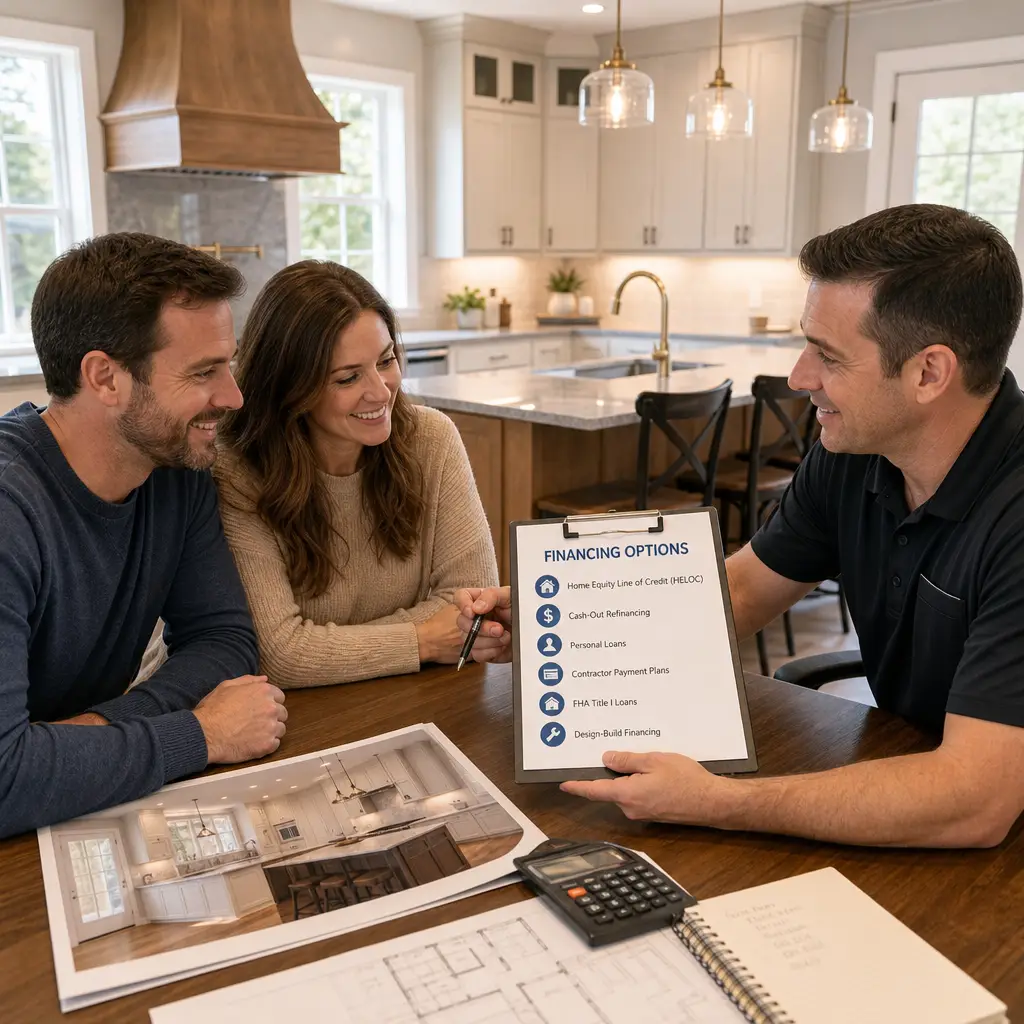
The Federal Housing Administration backs Title I loans specifically for home improvements. These government-backed loans are accessible to borrowers with modest credit scores and require no home appraisal.
Loan amounts typically max out around $25,000 to $40,000 depending on your location and lender. Rates are competitive because the government guarantees repayment. Approval takes 1-2 weeks if you work with an FHA-approved lender.
The limitation: Title I loans aren’t ideal for comprehensive kitchen remodels that exceed $40,000. They work better for focused upgrades like new cabinets, countertops, and appliances. If you’re adding square footage (an island, new layout, or extended footprint), you’ll likely exceed the loan cap and need supplementary financing.
What to do next: Contact FHA-approved lenders in Northern Virginia to confirm current loan limits in Fairfax County and request a pre-qualification letter.
6. Design-Build Financing Through Your Remodeling Contractor
Our approach to financing sets us apart. As a design-build firm, we integrate architectural planning, permit coordination, material sourcing, and construction into one cohesive team. This unified structure means we can work with you to align financing with design and construction phases, eliminating surprises and delays.
Here’s why this matters: traditional remodeling separates the designer, contractor, and lender into independent parties. Communication gaps create unexpected costs, material substitutions, and financing shortfalls. Our design-build model keeps everyone aligned.
We work with you to finalize the complete scope, provide transparent, detailed pricing, and coordinate financing before construction starts. You know exactly what the project costs, what it includes, and how payments align with construction milestones. We manage the relationship with your lender, submit invoices on schedule, and ensure funds flow when they’re needed.
For kitchen remodels across Alexandria, Arlington, Burke, Fairfax, McLean, Reston, and throughout Northern Virginia, this integrated approach reduces financial and logistical stress. You’re not juggling separate contractors, designers, and lenders during your remodel. You have one trusted partner managing the entire process.
What to do next: Schedule a consultation with us to discuss your kitchen vision and financing needs. We’ll walk you through our design-build process and show how our integrated approach keeps projects on time and on budget.
7. Savings and Phased Remodeling Approaches
If you have time before your kitchen remodel and want to minimize financing costs, a phased approach deserves consideration. Instead of funding a $75,000 complete remodel today, you might reface cabinets and replace appliances this year (year 1), then tackle countertops and backsplash next year (year 2), followed by layout changes and new flooring in year 3.
Phasing reduces your immediate borrowing need and lets you build equity over time. Each phase adds value, so you’re investing gradually rather than betting everything on one large project. From a financing perspective, you might only need a $20,000 personal loan or contractor payment plan in year 1, then save or finance the next phase separately.
The tradeoff: phasing extends your project timeline and often costs more per dollar of work (labor costs rise, material prices fluctuate, contractor availability becomes unpredictable). You also live in a partially renovated space longer, which can be disruptive.

Phasing makes sense if you’re unsure of your long-term goals or genuinely lack financing options. If you’re confident in your vision and can access reasonable financing, completing your kitchen remodel as one integrated project typically delivers better outcomes, faster completion, and cleaner results.
What to do next: Map out your ideal kitchen design and get a complete cost estimate. Compare the total investment against phasing costs over 2-3 years, including potential price inflation and repeated labor charges.
—
Choosing the right financing method depends on your credit profile, timeline, project scope, and comfort level with debt. Each option has merit, but the best choice depends on your specific circumstances.
At Elite Contractors Services, we’ve guided hundreds of Northern Virginia homeowners through this decision-making process. We recommend starting with a clear design and accurate cost estimate, then matching financing to that reality. We handle architectural planning, detailed upfront contracts, and transparent pricing so you know exactly what you’re financing before you borrow a dollar.
Whether you choose a HELOC, refinance, personal loan, or contractor financing, the key is moving forward with confidence. Your kitchen should feel great to use and reflect your lifestyle. Learn more about how our design-build approach simplifies the entire remodeling process, and let’s turn your kitchen vision into reality without the stress.
Contact us Today For a Free Estimate !
Frequently Asked Questions (FAQ)
What financing options does Elite Contractors Services recommend for kitchen remodels in Fairfax County?
We work with homeowners across multiple financing solutions tailored to their financial situation. Many of our clients use HELOCs or cash-out refinancing to access larger sums at competitive rates, while others prefer personal loans for faster approval timelines. We can also discuss our design-build financing approach, which integrates material selections and construction planning into a clear cost structure that works with your chosen lending method.
Does Elite Contractors Services offer payment plans directly to homeowners?
We partner with our homeowners to create transparent, upfront contracts that detail all costs and timelines, making it easier to coordinate with your preferred financing source. While we don’t operate our own in-house lending program, our detailed estimates and phased project approach help you work confidently with banks, credit unions, or other lenders. Our team is happy to provide documentation and project breakdowns to support your financing application.
How does the design-build process at Elite Contractors Services affect the total cost of my kitchen remodel?
Our design-build approach actually streamlines costs by combining architectural planning, permit coordination, and construction under one experienced team, eliminating the inefficiencies and communication gaps that can drive prices up. We provide detailed material selections and realistic budgets early in the process, so you know exactly what you’re financing before work begins. This transparency helps you make informed financing decisions and significantly reduces the risk of unexpected expenses.