Occupying a building without required approval can create serious legal and safety problems. A certificate of occupancy, or what is a certificate of occupancy, is a local government agency’s or building department’s confirmation that a building meets applicable codes and laws and is suitable for occupancy. In most U.S. jurisdictions, occupying a building before the required certificate is issued is illegal.
If you’re planning a renovation, addition, or change in how a property is used, it’s reasonable to wonder whether a certificate of occupancy applies to your project. Requirements vary by jurisdiction and by the type of work, so understanding what can trigger a certificate and what it confirms helps you plan your next steps.
It’s important to understand what is a certificate of occupancy before starting a renovation, as it applies to your project.
This article explains what a certificate of occupancy means, specifically what is a certificate of occupancy, when one may be required, how the application process generally works, and how it differs from a certificate of completion. It also covers temporary certificates and what to consider when dealing with an existing home or property transaction.
Key Takeaways
- Understand how this document confirms a building’s permitted use and suitability for occupancy.
- Learn which types of construction or changes in use may require approval before a space can be occupied.
- See how a temporary certificate can allow occupancy while qualifying work remains outstanding.
- Follow the general application path, from required permits and inspections to final approval.
- Distinguish occupancy approval from proof that construction work has been completed.
What Is a Certificate of Occupancy?
Understanding what is a certificate of occupancy is crucial for homeowners and builders alike.
A certificate of occupancy, or what is a certificate of occupancy, is issued by a local building department or government agency. It confirms that a building meets applicable codes and laws and is suitable for occupancy.
It also identifies the building’s occupancy classification and permitted use. That approved use matters because a certificate for one type of occupancy doesn’t automatically authorize another. This is why knowing what is a certificate of occupancy is essential.
Situations Requiring a Certificate
In the United States, a certificate is generally required for new construction, a change in a building’s use, or certain occupancy or ownership changes. Approval for one use doesn’t automatically authorize another.
For example, converting a building to a different usage classification may require a new or amended certificate. Under Section 111.1 of the International Building Code, a building or structure generally can’t be used or occupied, or change occupancy classification, until the building official issues the certificate.
In these situations, knowing what is a certificate of occupancy can guide your compliance with local regulations.
Section 105.2 of the International Building Code exempts certain work from permitting, and work covered by that exemption doesn’t require a certificate of occupancy. Local rules and project scope determine whether an exemption applies. A building permit is a separate step, generally filed with the local authority before construction to show proposed work will follow applicable codes and laws.
Occupancy classification groups buildings by intended purpose and related risks to occupants. Section 302.1 of the International Building Code describes this classification framework. A certificate’s stated use therefore matters when a property’s function changes, even if the physical building remains the same. The classification helps distinguish the approved use from a proposed new use.
Can you sell, rent, or occupy a property without a certificate? In most U.S. jurisdictions, knowing what is a certificate of occupancy is important because occupying a building before its required certificate is issued is illegal.
Inspection Requirements
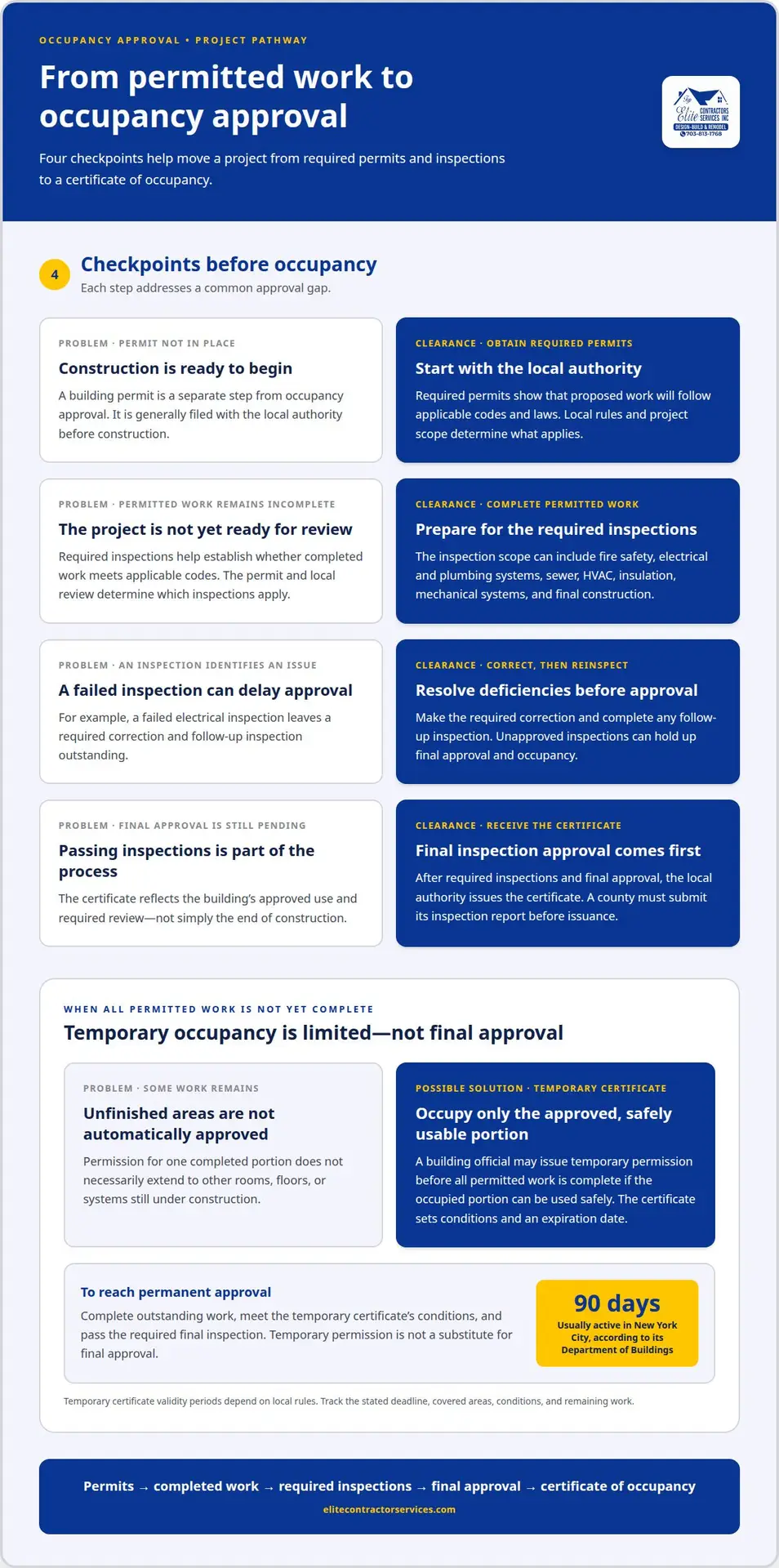
Required inspections help establish that completed work meets applicable codes before the certificate is issued. They matter because an unapproved inspection can delay final approval and occupancy.
Depending on the project, inspections may cover fire safety, electrical and plumbing systems, sewer, HVAC, insulation, mechanical systems, and final construction. The permit and local review determine which inspections apply to a specific building.
The usual sequence is to obtain required permits, complete permitted work, pass required inspections, and receive final inspection approval. The local authority then issues the certificate. A county also needs to submit the inspection report before issuing one.
If an inspection identifies a problem, it must be corrected and inspected again before approval. For example, a failed electrical inspection means the required correction and follow-up inspection remain part of the approval process. The certificate reflects the building’s approved use and required review, not simply the end of construction.
Temporary Certificates of Occupancy
A temporary certificate of occupancy may bridge the gap while you wait on what is a certificate of occupancy to be finalized.
A temporary certificate of occupancy can allow a building, or a safely usable part, to be occupied while permitted work remains unfinished. Under Section 111.3 of the International Building Code, a building official may issue one before all permitted work is complete if the occupied portion can be used safely. This provides limited permission for the approved area, not automatic approval for every unfinished space.
A temporary certificate is not a substitute for final approval. It sets conditions and an expiration date, and the owner must complete outstanding work and pass final inspection to obtain a permanent certificate. For example, an authority might allow occupancy in completed rooms while construction continues elsewhere, if the occupied space can be used safely.
Validity periods depend on local rules. In New York City, temporary certificates of occupancy are usually active for 90 days from the date they are issued, after which they expire, according to the New York City Department of Buildings. Owners need to track the stated deadline and remaining work so temporary permission doesn’t lapse before final approval, especially when what is a certificate of occupancy is involved.
The certificate’s approved scope matters. Permission to occupy one completed portion doesn’t necessarily extend to other floors, rooms, or systems still under construction. Review the document’s conditions, covered areas, and expiration date separately. Temporary approval applies only to the portion and use identified by the issuing department.
To move toward permanent approval, complete outstanding work and arrange the required inspections. If an inspection identifies a deficiency, address the correction and any required follow-up inspection before final approval. Keeping the temporary conditions, work status, and inspection records aligned clarifies what remains before the permanent certificate can be issued.
A certificate can also be suspended or revoked. Under Section 111.4 of the International Building Code, a building official may suspend or revoke one in writing if it was issued in error, relied on incorrect information, or the building violates applicable codes or local ordinances. The written notice and stated reason explain the basis for that action.
What are the risks and penalties for lacking a valid certificate of occupancy? In most U.S. jurisdictions, occupying a building before its required certificate is issued is illegal. Opening without one can lead to lawsuits or repeated fines, and tenants may be able to break a lease or sue to recover money.
Understanding what is a certificate of occupancy can help you avoid the risks and penalties associated with lacking one.
For a renovation where some areas may be used before all work is complete, thoughtful coordination can help keep construction and approval requirements organized. Plan your renovation carefully as the work moves toward final approval.
Certificate of Occupancy application process
The application process depends on the local authority, the building, and the work completed. Generally, the applicant submits required forms and supporting records, completes applicable reviews and inspections, and receives the certificate after approval. Residential and commercial projects can involve different forms, reviews, and inspections, so the intended use and project scope shape the submission.
A general contractor typically handles the application, though the owner or someone acting on the owner’s behalf may apply. The applicant coordinates project records with the authority’s requirements. Records can include permits, inspection results, approved plans, and information about the building’s intended occupancy and use. An organized, complete submission helps the department review the project against relevant requirements.
Plans and supporting documents help the department assess completed work against approved project details. Depending on the project, records may include construction, plumbing, elevator, and electrical sign-offs, a final building survey, and an occupancy schedule. Applications may also require owner affidavits or other documents related to the work. Open applications or violations can affect the review and may need to be resolved before approval.
Submission methods vary by jurisdiction. Some authorities accept online applications through dedicated systems, while others use different filing procedures. Follow the local authority’s process and submit required forms and records through its designated channel. Electronic applications may involve pre-processing before formal review. Missing documents can delay progress if the department needs them before continuing.
After submission, technical or operations staff may review the application, supporting records, and inspection status. The authority may request additional material if the file doesn’t address a required item. The applicant then supplies the requested documentation through the applicable process. Keeping plans, permits, inspection results, and occupancy information organized makes it easier to respond consistently and avoid mismatched project records.
Processing time varies by jurisdiction and workload. After final inspection approval, issuance may take from the same day to a few weeks. The review period depends on the authority’s procedures and whether the application is complete. Some jurisdictions set processing windows after receiving complete materials, while others process requests according to their review workload.
In conclusion, knowing what is a certificate of occupancy is vital for ensuring compliance with building laws and regulations.
Plan the application around project records and final approvals. The authority reviews the submission, resolves outstanding requirements, and issues the certificate when its criteria are met. For a major renovation, coordinating plans, permits, inspection records, and occupancy details throughout construction can make the final application clearer and keep the review focused on the completed project.
Certificates of occupancy for existing homes and property transactions
An existing property may already have a certificate of occupancy, but its age and history affect which records are available. If you’re considering a purchase, sale, or planned renovation, check whether the recorded certificate matches the building’s current use. A certificate describes permitted use, so an older document may not reflect later changes to occupancy or egress.
Start by searching the local building department’s records using the property address. If you find a certificate, review its occupancy classification and permitted use alongside the property’s current layout. If no record appears, that result doesn’t by itself explain why. Older buildings may predate local certificate requirements, while later alterations may have changed whether a certificate was needed.
New York City offers address-based searches through different records systems, depending on when the request was made. Requests made before March 1, 2021, can be searched in the Buildings Information System. Requests made on or after March 1, 2021, can be searched in DOB NOW. For buildings built before 1938, a certificate generally wasn’t required unless later alterations changed use, egress, or occupancy.
For a New York City building built or altered before 1938, a Letter of No Objection may confirm its legal use if a certificate wasn’t required at that time. This provides a separate records route for some older properties. It doesn’t mean every building from that period qualifies; the relevant question is whether the building’s construction or alterations fell under the earlier requirements.
Phoenix handles record checks differently. A public records request to check for an existing certificate typically takes three to five business days to process. If a Phoenix property has no certificate or permit history on file, the owner can contact the Planning and Development Department Ombudsman team by email. These records help clarify the documented history, but don’t by themselves establish that the building is safe or resolve every question about current use.
A change in ownership doesn’t always mean a new certificate is required. In San Antonio, a change of owner or lessee in an existing building or tenant space doesn’t require a new certificate if the type of use remains basically the same. The existing certificate can instead be updated through a name-change application. If the proposed business type differs from the type currently operating, a new certificate is needed.
For a transaction, distinguish a missing record from a known change in use. Search by address, identify the system or department holding the records, then compare the certificate’s permitted use with the property’s actual use. If the building is older, the New York City pre-1938 rules or a Phoenix permit-history search may help explain what the available records show.
Certificate of occupancy versus certificate of completion
A certificate of occupancy and a certificate of completion document different aspects of a building project. The occupancy certificate identifies permitted use and occupancy classification, while a completion document generally records that specified work has been completed. A completion record alone isn’t proof that a building has occupancy approval. The document’s title, issuing authority, and project scope all matter.
For example, a certificate of occupancy connects a building or space to its approved use. This distinction can matter to an owner, buyer, or tenant checking whether a space may be used as intended. A certificate of completion relates to the work described in the record. It doesn’t necessarily address the building’s permitted occupancy classification or establish that all applicable occupancy approvals are in place.
The terms and documents used vary by jurisdiction and project. In New York City, a Letter of Completion may be issued for minor alterations that don’t require a new or amended Certificate of Occupancy. This example shows why “completion” and “occupancy” aren’t interchangeable: the city may document completed minor work without changing the building’s occupancy certificate.
Consider a tenant space with completed interior alterations. A completion document may relate to those alterations, while the occupancy certificate identifies the space’s approved use. If the work changes use, egress, or occupancy, check whether the existing occupancy document still reflects the approved conditions. The completion record alone doesn’t answer that question.
To understand a document’s role, start with its exact title and issuing authority. Then identify the property address, the work or space it covers, and any stated use or occupancy classification. Compare those details with the question you’re trying to answer. For example, someone reviewing completed renovation work needs different information from a tenant confirming a space’s permitted use.
Keep both records together when a project has separate completion and occupancy documents. The completion document can show what work the record covers; the occupancy certificate addresses the building’s permitted use. If a document refers to outstanding work or a limited scope, don’t assume it replaces another approval. The issuing authority and wording on each record clarify what it establishes.
For an existing property, these documents can tell different parts of its project history. A completion record may relate to a particular alteration, while the occupancy certificate may reflect an earlier approved use. Read them as separate records, not substitutes. This distinction helps owners, buyers, and tenants understand whether they’re reviewing evidence of finished work or information about permitted occupancy.
Elite Contractor Services
If a planned home renovation raises questions about permits, inspections, or occupancy approval, understanding what is a certificate of occupancy can help. Elite Contractor Services can help plan the construction with care.
Bring your project goals and relevant property or permit records to the planning conversation. This context helps shape the scope of work and clarify how proposed changes relate to your home. For major remodeling, a coordinated plan makes construction decisions easier to follow as work progresses.
Contact Elite Contractor Services to discuss your home remodeling plans.
Plan Your Next Home Project With Clarity
Before planning a renovation, consider what is a certificate of occupancy to ensure all legal requirements are met.
Before planning a renovation, addition, or change to your home, include occupancy approval in the discussion. Understanding what a certificate of occupancy means helps connect the intended use of a space with the work and documentation your project may involve. The local building department makes approval decisions, while clear project planning helps keep construction details organized.
For homeowners considering an addition, the proposed changes and their effect on the property’s use are useful starting points. Elite Contractor Services offers Home Additions alongside remodeling, giving homeowners a construction partner as they consider project goals and next steps. Bring your plans and relevant property records to the discussion to help establish a clear scope of work.
Every home project has its own priorities. A thoughtful conversation can help you move from questions about occupancy requirements toward a well-organized remodeling plan. Contact Elite Contractor Services today to discuss your home project and take the next step with confidence.
Frequently Asked Questions About What Is a Certificate of Occupancy
What is a certificate of occupancy (CO) in the United States?
A certificate of occupancy (CO) is an official local record confirming that a building is approved for occupancy under applicable requirements. If you’re wondering, what is a certificate of occupancy, it identifies the building’s occupancy classification and permitted use. For example, the record can help distinguish a residence from a space approved for another purpose.
What information does a certificate of occupancy include?
Depending on the local format, a certificate may identify the building’s permitted use and occupancy classification. Section 111.2 of the International Building Code specifies information a certificate must contain. The classification reflects the building’s intended purpose and related occupant risks, as described in Section 302.1. For a tenant or buyer, these entries help clarify the use recorded by the authority.
When is a certificate of occupancy required?
Across the United States, a certificate is generally required for new construction or a change in a building’s use classification. This is where knowing what is a certificate of occupancy becomes crucial.
Who issues a certificate of occupancy, and how do you apply?
A local government agency or building department issues the certificate. For those asking what is a certificate of occupancy, a general contractor typically handles the application, though the owner or someone acting for the owner may apply.
What inspections are required to obtain a certificate of occupancy?
Required inspections depend on the building and permitted work. They may cover fire safety, electrical and plumbing systems, HVAC, insulation, mechanical systems, or final construction. A project involving particular systems may need those areas inspected before final approval. The local authority determines which inspections apply, and identified deficiencies must be corrected and reinspected before approval can proceed.
How much does a certificate of occupancy cost, and how long does it take?
Understanding what is a certificate of occupancy will help you navigate the required inspections needed for approval.
After final inspection approval, processing can range from the same day to a few weeks, depending on local workload and procedures. For example, Philadelphia processes applications within 20 business days. Online applications there require an additional business day for pre-processing beyond the stated processing time.
What are the steps to get a certificate of occupancy for a new building or renovated property?
For a new building or renovation, the usual sequence is to obtain required permits, complete approved work, pass applicable inspections, then submit the certificate request and supporting records. The building department reviews the submission and issues the document after required approvals are complete. For example, a renovation that changes a space’s use may need occupancy details matching the proposed use, not just records of completed construction.
How do certificate of occupancy rules vary by city, county, and state?
As such, it’s important to be aware of what is a certificate of occupancy when planning your project.
Local rules differ on when a certificate is required, which inspections apply, how applications are filed, and how long review takes. New York City uses DOB NOW: Build for certain requests, so understanding what is a certificate of occupancy is essential for compliance.