Table of Contents – Basement ADU Fairfax County
Explore the benefits of a Basement ADU Fairfax County, which can provide additional income and enhance property value.
Transforming your property with a Basement ADU Fairfax County not only creates a living space but also serves as an investment opportunity.
- Design-Build Approach to Creating Code-Compliant Basement Living Spaces
- Essential Basement Features That Make Your Space Legally Rentable
- Our Complete Process From Concept to Certificate of Occupancy
- Budget-Friendly Basement Suite Conversions With Transparent Pricing
- Real Results: Fairfax County Homeowners Who Added Rental Income
- Common Basement Conversion Mistakes We Help You Avoid
- Next Steps: Let Our Team Plan Your Legal Basement Suite
- Frequently Asked Questions (FAQ)
Why Fairfax County Homeowners Are Converting Basements Into Revenue-Generating Spaces
The housing market in Northern Virginia continues to shift in favor of homeowners who think strategically about their property’s potential. More families in Fairfax County are asking a straightforward question: why let a finished basement sit empty when it could generate steady rental income?
Implementing a Basement ADU Fairfax County can enable homeowners to maximize their property’s potential and generate consistent rental income.
We’ve watched this trend accelerate over the past few years. Multigenerational living is becoming the norm rather than the exception. Adult children return home after college or a career transition. Aging parents need care closer to family. Young professionals seek affordable housing in tight rental markets. Meanwhile, many Fairfax County homeowners realize their basements offer untapped value.
A legal basement suite solves real problems for real people. It provides rental income that offsets your mortgage or property taxes. It creates flexible living space for family members without requiring you to leave your neighborhood. It increases your home’s overall value by adding a separate, income-generating unit. Most importantly, when done correctly through the proper permits and code-compliance process, it protects your investment and keeps you on the right side of local zoning laws.
Additionally, a Basement ADU Fairfax County can be tailored to meet specific needs, offering flexibility for homeowners and tenants alike.
Unlike quick DIY conversions or informal arrangements, a legally permitted basement ADU is an asset, not a liability.
The Financial Case for a Legal Basement Suite on Your Property
Let’s talk numbers, because this is where the decision becomes concrete for most homeowners.
In Fairfax County and surrounding areas, a legal one-bedroom basement suite in good condition typically rents for $1,200 to $1,800 per month, depending on size, finishes, and location. A two-bedroom suite commands $1,600 to $2,400. Over a year, even a conservative rental rate of $1,400 monthly generates $16,800 in gross income, which can cover a significant portion of your mortgage, property taxes, or home maintenance costs.
Considering the average rental rates for a Basement ADU Fairfax County, homeowners can expect a return on investment that is both lucrative and sustainable.
But the financial case goes deeper. We help homeowners understand several layers of value:
Monthly cash flow: Rental income becomes predictable revenue that covers your carrying costs or builds savings.
Property appreciation: Studies show that homes with legal ADUs sell for more than comparable properties without them. You’re not just capturing rental income during your ownership, you’re building equity.
Tax deductions: A legal rental unit allows you to deduct mortgage interest, property taxes, utilities, maintenance, and depreciation related to that space (consult a CPA for specifics).
Long-term flexibility: You maintain control of your property while earning income. If you need the space for family, you reclaim it. If you want to sell, the ADU becomes a major selling point for buyers seeking multigenerational potential.
Furthermore, a Basement ADU Fairfax County contributes to the overall value of the property, making it a wise financial move.
Inflation hedge: Unlike fixed savings, rental income typically increases with market conditions over time.
The upfront investment in a code-compliant basement conversion typically ranges from $50,000 to $100,000, depending on the scope of work. With rental income of $14,000 to $22,000 annually, your payback period is usually 5 to 8 years, after which you’re generating pure income.
Understanding Fairfax County Zoning and Permit Requirements for Basement ADUs
This is where many homeowners stumble, and frankly, it’s the most critical step. You cannot legally rent a basement space in Fairfax County without understanding local zoning ordinances and securing the proper permits.
Understanding the zoning laws for a Basement ADU Fairfax County is crucial for ensuring compliance and maximizing the unit’s potential.
Fairfax County allows accessory dwelling units under specific conditions. The zoning code (currently Sections 4-600 series) permits ADUs in residential zones, but each property must meet certain requirements:
Single-family residential zoning: Your property must be zoned for single-family use. Some properties allow ADUs more easily than others.
Minimum lot size: Requirements vary, but many ADU-friendly zones require at least a certain acreage or lot size. A small urban lot may face restrictions that a larger suburban property doesn’t.
Owner-occupancy: Fairfax County typically requires that the owner occupy one of the dwelling units (either the main house or the ADU). You cannot convert a basement and turn your home into an investment property you don’t personally occupy.
Separate entrance and utilities: A legal basement suite must have its own entrance (not through the main house), separate water/sewer meters, and independent utilities where required.
Incorporating a separate entrance is essential for a Basement ADU Fairfax County, enhancing the privacy and functionality of the space.
Parking requirements: The ADU must provide adequate parking on-site. This varies by location.
Height and setback standards: The structure itself must meet zoning setbacks and height restrictions.
Permit process: You’ll need a zoning verification letter, site plan review, building permits, electrical permits, plumbing permits, and a final Certificate of Occupancy from the county.
We’ve navigated this process hundreds of times. The key is not to guess or assume your property qualifies. We conduct a zoning analysis early in any conversation to confirm your property is eligible. Working with incorrect assumptions wastes time and money.
We specialize in creating attractive Basement ADU Fairfax County projects that not only meet legal standards but also resonate with potential renters.
Design-Build Approach to Creating Code-Compliant Basement Living Spaces
Our design-build method exists specifically because basement conversions require expertise that spans architecture, engineering, code compliance, and construction coordination.
When we take on a basement project, our team works as one unit from day one. Our designers meet with you to understand how you want the space to function. Are you creating a one-bedroom suite for rental? A studio? Do you need a full kitchenette or just a efficiency kitchen? Our architects then develop a design that meets your needs while satisfying every Fairfax County code requirement.
Simultaneously, our engineers assess your basement’s structure, drainage, egress windows, ventilation, electrical load capacity, and plumbing access. Many basement conversions fail because these systems weren’t properly planned. We identify potential issues upfront rather than discovering them mid-construction when changes become expensive.
Building a Basement ADU Fairfax County requires careful planning and execution, ensuring all aspects are code-compliant and aesthetically pleasing.
Once the design is locked, we handle all permit applications, submittals, and revisions with the county. We’ve worked with Fairfax County planners and inspectors long enough to understand exactly what they require to avoid delays. This is not bureaucratic busywork; it’s the foundation of a legally compliant, insurable, and saleable property improvement.
During construction, our field teams execute the design with precision. Egress windows are properly sized and installed. Mechanical systems are designed for the space and code-compliant. Electrical systems anticipate both current and future needs. Plumbing is separate from the main house system where required. Every trade works from the same set of coordinated plans, which eliminates the stop-and-start confusion of traditional contractor management.
The design-build advantage for basement suites is this: you’re not coordinating five different contractors who don’t talk to each other. You have one team accountable for the entire outcome.
Essential Basement Features That Make Your Space Legally Rentable
Not every basement conversion creates a legal rental unit. Specific features are non-negotiable for code compliance and tenant safety.
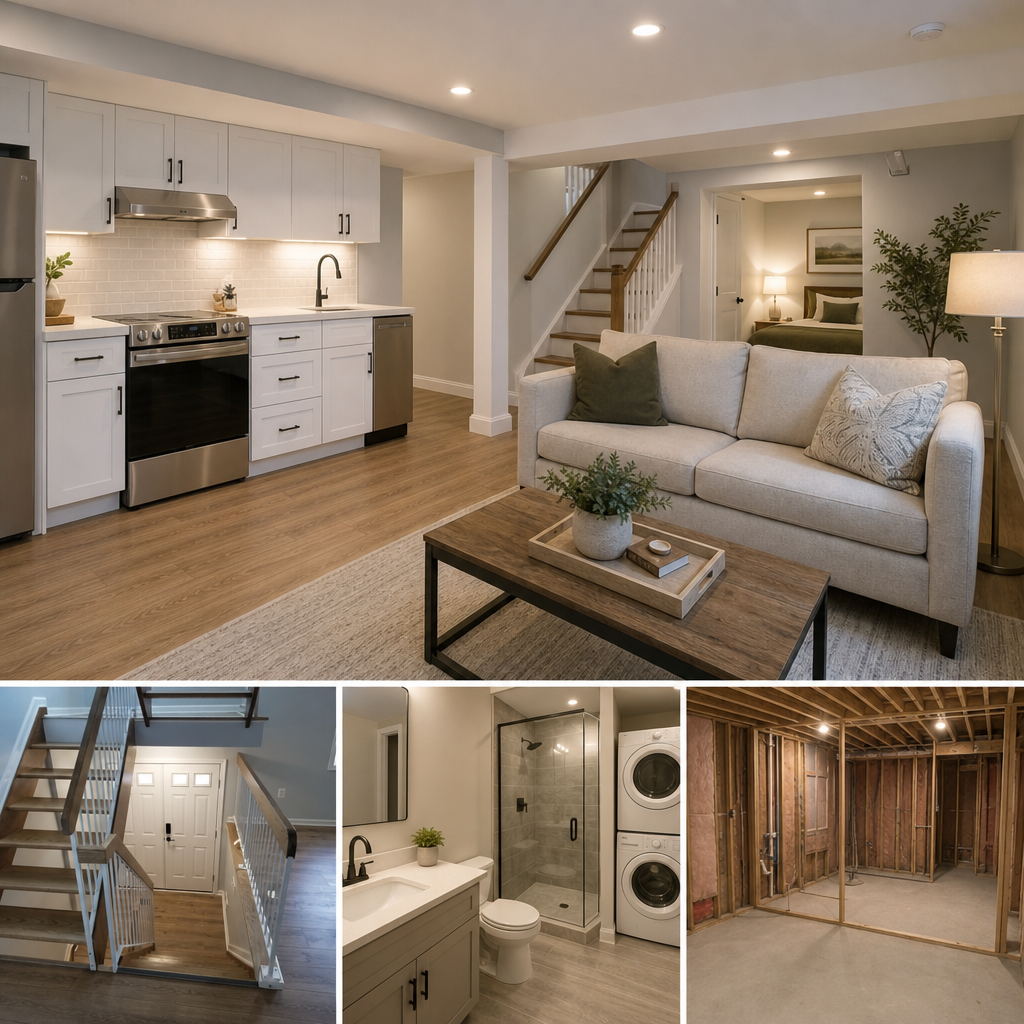
Egress windows: Every sleeping room must have a window that meets minimum size requirements (usually 5.7 square feet of glass) and can be opened from inside without tools. This is your most critical code item. We size and install egress windows to meet Fairfax County standards and provide a safe emergency exit.
Ceiling height: The ceiling must be at least 7 feet 6 inches in 75% of the room. Finished basements often have low ceilings; this sometimes requires structural adjustments like lowering the basement floor or relocating mechanical systems overhead.
Separation from main house: The ADU needs its own entrance from outside, not a door from the main residence. This means grade-level or ramp access, weatherproofing, and security hardware. It also means separate metering for utilities.
Kitchen facilities: A legal rental unit requires a kitchen or kitchenette with a sink, cooking surface, and refrigeration. Full kitchens are ideal, but efficiency kitchens satisfy code in smaller spaces.
Bathroom with tub or shower: At least one full bathroom, including a toilet, sink, and a tub or shower enclosure that meets plumbing codes.
HVAC and ventilation: The unit must have adequate heating and cooling, with dedicated ventilation for the kitchen and bathroom. Mechanical systems designed for the space prevent moisture and indoor air quality issues.
Moisture and waterproofing: Basements require extra attention to drainage, vapor barriers, and waterproofing. We ensure the space stays dry year-round, which protects the structure and makes it rentable.
Fire safety: Smoke and carbon monoxide detectors, emergency egress, and fire-rated separation from the main house are required. Some jurisdictions require additional fire suppression.
Electrical capacity and outlets: The panel must have adequate capacity to serve the new unit. We run dedicated circuits for the kitchen, bathrooms, and general lighting and outlets.
These aren’t optional. Each one is a county code requirement, and inspectors verify them before issuing a Certificate of Occupancy.
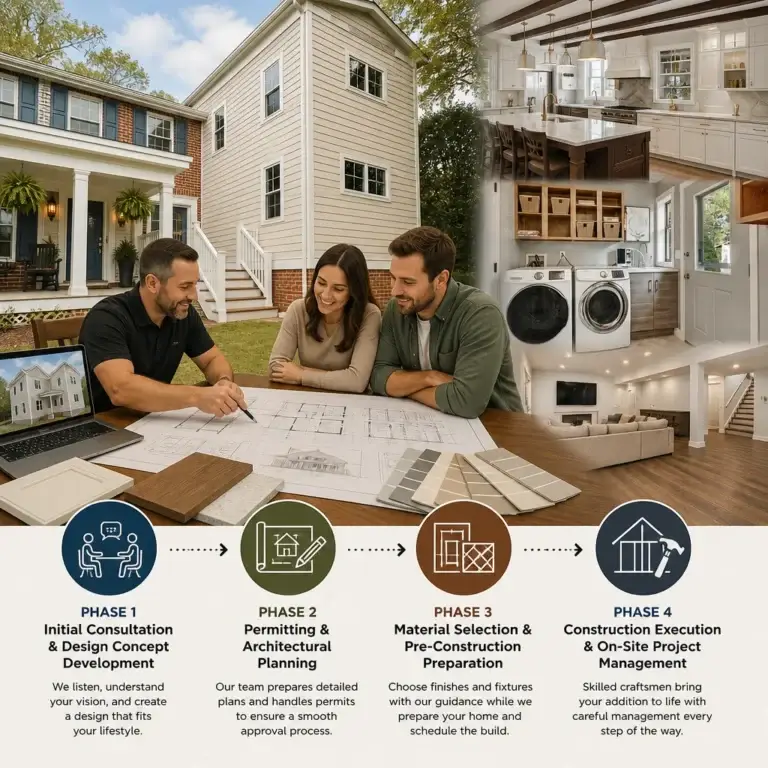
Our Complete Process From Concept to Certificate of Occupancy
We’ve streamlined our basement ADU process so you know exactly what happens, when, and what to expect.
Our streamlined process for a Basement ADU Fairfax County helps homeowners navigate the complexities with ease and confidence.
Phase 1: Consultation and Zoning Analysis (1-2 weeks)
You meet with our team to discuss your vision, budget, and timeline. We ask detailed questions about who will occupy the space, how long you want to hold it, and what income goals you have. We then conduct a zoning analysis, review your property against county code, and confirm eligibility. We provide a written assessment with recommendations.
Phase 2: Design Development (3-6 weeks)
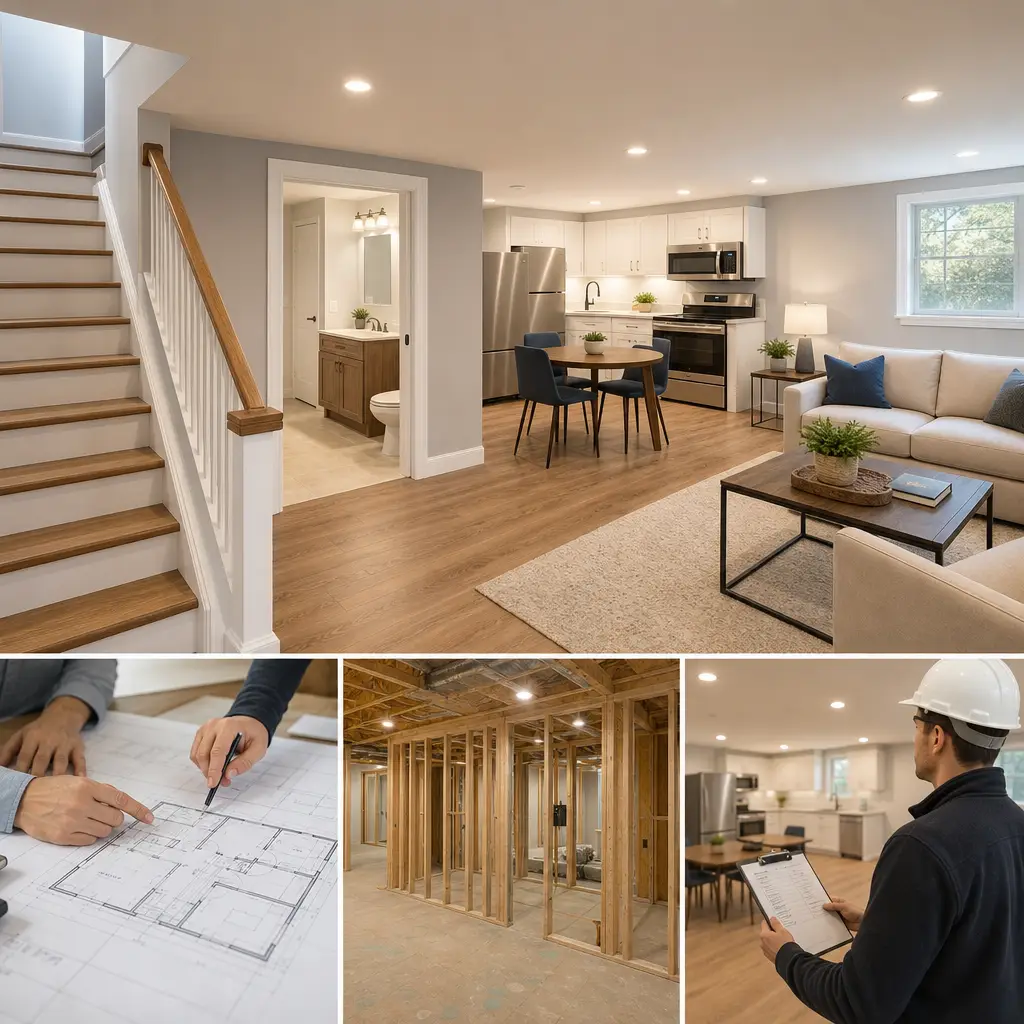
Our designer and architect work with you to develop floor plans, elevations, and 3D renderings. We discuss layout options, finishes, appliances, and features. You see exactly what the space will look like before construction begins. We also integrate engineering assessments for structure, MEP systems, and drainage.
Phase 3: Permit Preparation and Submission (2-4 weeks)
We prepare all required permit applications, including the site plan, architectural drawings, MEP plans, and zoning verification. We submit to Fairfax County and track the review process. County planners typically request revisions; we coordinate those and resubmit.
Phase 4: Permit Approval (4-8 weeks typical)
Fairfax County reviews and approves the permits. This timeline varies based on complexity and county workload. We maintain regular communication with you during this waiting period so you’re never in the dark.
Phase 5: Construction and Inspections (8-16 weeks)
Once permits are issued, our crews begin demolition, structural work, MEP installation, and finishing. County inspectors conduct inspections at key milestones: foundation/structure, rough-in (electrical/plumbing/HVAC), and final. We schedule and coordinate all inspections and address any inspector notes promptly.
Phase 6: Final Walkthrough and Certificate of Occupancy (1-2 weeks)
Once all inspections pass and the space is complete, the county issues a Certificate of Occupancy. We conduct a final walkthrough with you, demonstrate all systems, and provide operation manuals. You now have a legal, insurable, rentable ADU.
Ultimately, completing a Basement ADU Fairfax County not only enhances your living space but also your financial outlook.
The entire process from first conversation to move-in typically takes 4 to 6 months, depending on county timelines and construction complexity.
Budget-Friendly Basement Suite Conversions With Transparent Pricing
We believe you should know what a basement conversion costs before committing. That’s why we provide detailed, upfront estimates that break down every phase and every cost category.
A typical one-bedroom basement ADU in Fairfax County costs between $50,000 and $85,000, depending on several variables:
Structural work: If your basement requires floor lowering, additional support beams, or joist reinforcement, structural costs range from $3,000 to $12,000. If minimal structural work is needed, this can be under $2,000.
Egress windows and installation: Professional egress window installation (typically one or two windows) runs $3,000 to $6,000 per window, including framing and waterproofing.
HVAC and mechanical: Extending heating and cooling to the basement and adding dedicated ventilation costs $6,000 to $12,000 depending on your existing system and space layout.
Plumbing: A new kitchenette and full bathroom with separate metering typically costs $8,000 to $15,000.
Electrical: New panel upgrades, circuits, and outlets for the ADU run $4,000 to $8,000.
Finishes: Drywall, flooring, painting, cabinetry, and appliances vary widely. Basic finishes cost $12,000 to $20,000; mid-range finishes, $20,000 to $35,000.
Investing in a Basement ADU Fairfax County can significantly improve the functionality and value of your home.
Permits and design: Professional drawings, permit fees, and inspections add $3,000 to $6,000.
Contingency: We recommend 10-15% contingency for unforeseen conditions ($5,000 to $8,000).
This breaks down to roughly $150 to $250 per square foot for a finished basement suite, which is competitive for the Fairfax County market.
We provide itemized contracts with fixed pricing wherever possible. You know your costs upfront, and we stand behind them. Change orders are documented in writing, and we don’t proceed with extra work without your approval.
Real Results: Fairfax County Homeowners Who Added Rental Income
Numbers on a spreadsheet feel abstract. Real stories feel real.
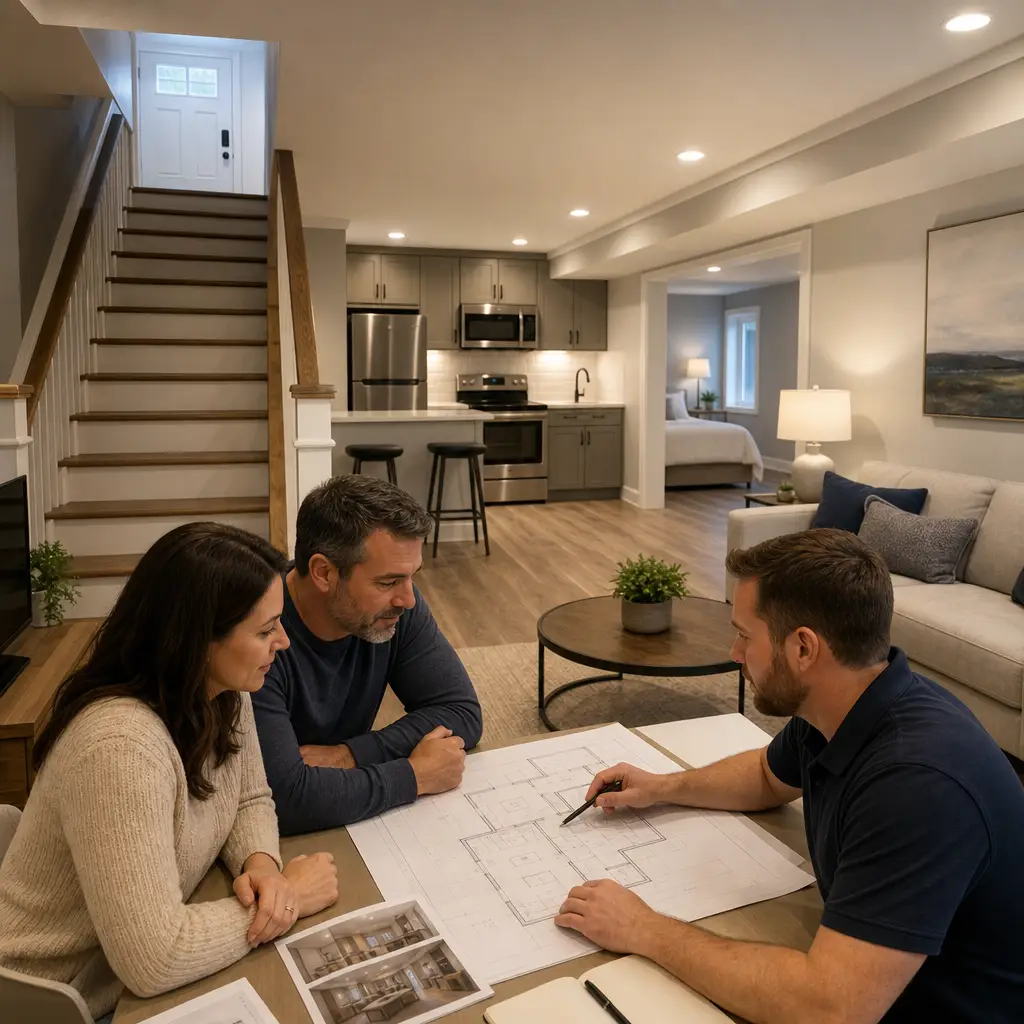
One Annandale homeowner had a finished basement gathering dust. Adult children had moved out, and the space sat vacant. After we converted it to a legal one-bedroom ADU, she rented it to a young professional at $1,500 monthly. That income now covers her property taxes entirely, and she’s built enough equity to consider a second property investment.
By converting to a Basement ADU Fairfax County, homeowners can share spaces while maintaining independence.
A McLean family wanted to bring an aging parent into their home without expanding the main house. We carved out a legal one-bedroom suite with a separate entrance, kitchenette, and full bathroom. The parent has independence and privacy; the family has peace of mind. They later learned the suite added an estimated $50,000 to the home’s appraised value.
A Burke couple needed a way to offset rising costs after a career change. Their basement sat unfinished. We designed and built a studio-style ADU with a kitchenette and bathroom. Renting at $1,200 monthly now covers their mortgage, allowing them to invest the rest of their income. When they sell in a few years, the ADU will be a major selling feature.
An Arlington homeowner used the project to modernize outdated systems. The basement had old wiring and poor drainage. A full ADU conversion meant upgrading everything to current code while creating an additional income stream. The property is now significantly more valuable and more comfortable to live in.
These aren’t outliers. We’ve completed ADU construction Fairfax VA projects across Arlington, Alexandria, Great Falls, Springfield, Tysons, Vienna, and throughout the county. The pattern is consistent: homeowners who convert basements into legal rental units gain both income and property value.
Common Basement Conversion Mistakes We Help You Avoid
We’ve seen enough mistakes to know which ones cost homeowners the most time and money.
Skipping the zoning analysis: The biggest mistake is assuming your property qualifies without official confirmation. We’ve met homeowners who spent $10,000 on preliminary design only to learn their lot is too small or their zoning doesn’t permit ADUs. Always verify zoning first.
Investing time in planning for a Basement ADU Fairfax County ensures you avoid common pitfalls and maximize your investment.
DIY permits and code shortcuts: Some homeowners try to save money by pulling permits themselves or cutting corners on code compliance. Unpermitted work creates problems when selling, insuring, or renting. A lender or buyer’s inspector will find it, and the cost to bring it into compliance often exceeds the original construction cost.
Inadequate egress design: Egress windows are expensive and conspicuous. We’ve seen homeowners try to satisfy the requirement with undersized windows or windows in the wrong locations. This fails inspection and must be redone, costing thousands in rework.
Ignoring moisture and drainage: Basements are inherently prone to moisture. Building a nice suite that becomes moldy within a year is a disaster. Proper drainage, vapor barriers, and ventilation aren’t optional.
Undersized HVAC and utilities: A basement ADU adds load to your electrical panel, heating and cooling systems, and water usage. If these systems aren’t properly sized, the space is uncomfortable and unsellable.
Poor separation from main house: A door between the ADU and the main house violates code and makes the unit unmarketable. A legal ADU must have complete separation.
Missing kitchen or bathroom requirements: Attempting to rent a space with a half-bath or no cooking facilities violates code and lease agreements.
We prevent these mistakes through our upfront analysis, detailed design process, and experienced project management. When issues come up during construction, we identify them immediately and address them before they derail the schedule.
Next Steps: Let Our Team Plan Your Legal Basement Suite
If you own a home in Fairfax County or surrounding Northern Virginia areas and you’re considering a basement conversion, now is the time to explore the opportunity with confidence.
There is no better time to consider a Basement ADU Fairfax County for your property than now.
Start with a conversation. Contact us to schedule a no-obligation consultation. Bring your property address, photos of your basement, and a general sense of what you’d like the space to become. We’ll walk through your zoning eligibility, discuss the realistic costs and timeline, and answer your questions.
If your property qualifies, we’ll provide a detailed zoning analysis and preliminary design proposal. You’ll see exactly what’s possible before you decide to move forward.
We handle everything from here: the design, the permits, the construction, the inspections, and the final Certificate of Occupancy. You gain a legal, income-generating asset without the stress of coordinating multiple contractors or navigating county requirements alone.
Fairfax County homeowners have real opportunities to improve their financial flexibility and property value through legal basement ADU conversions. We’ve built a process that makes this transformation smooth, transparent, and professionally executed.
With a Basement ADU Fairfax County, the potential for generating income and increasing property value is immense.
Ready to learn more? Reach out to Elite Contractors Services today. We’re ready to help you convert your basement into a valuable, legal rental suite.
Contact us Today For a Free Estimate !
Frequently Asked Questions (FAQ)
Understanding the requirements for a Basement ADU Fairfax County is essential for a successful conversion.
What permits and inspections do we need to convert our basement into a legal rental unit in Fairfax County?
We handle all permit coordination for you, which is essential since Fairfax County requires multiple approvals for basement ADUs. You’ll need a building permit, electrical permit, plumbing permit, and a Certificate of Occupancy before you can legally rent the space. Our team submits all required documentation, manages inspections at each stage, and ensures your basement meets current zoning codes for egress windows, ceiling height, and fire safety so you avoid costly rework later.
How much does it typically cost to finish a basement as a rentable ADU?
Basement suite conversions vary based on your current space condition, finishes, and whether you need structural work, but we provide detailed upfront pricing before any construction begins. A basic conversion with essential features (bedroom, bathroom, kitchenette, egress window, and proper ventilation) typically ranges from $75,000 to $150,000 depending on square footage and your choices. We work with you to prioritize spending on code-required items versus upgrades so you can make informed decisions about your budget.
The investment in a Basement ADU Fairfax County can vary, but the benefits often outweigh the costs.
Why should we choose a design-build approach instead of hiring separate architects and contractors?
Our design-build model combines architectural planning, permits, material selection, and construction into one coordinated team, which eliminates communication gaps and delays between different firms. You get a single point of contact, transparent project management, and professionals who are invested in delivering on-time and on-budget because we’re accountable for the entire project, not just one phase.