What if your property could generate over $2,000 in monthly revenue while increasing your home’s market value by up to $350,000? With the 2026 implementation of Virginia’s SB 531, maximizing your ADU for rental income potential Northern VA has evolved from a complex dream into a viable, high-yield reality. You know the financial benefits are there, yet the fear of navigating fragmented zoning laws or confusing “Accessory” units with “Affordable” housing mandates often leads to more questions than answers.
It’s natural to feel overwhelmed by the technical hurdles and the potential for budget overruns. We understand that you’re looking for a predictable, high-quality experience that doesn’t disrupt your daily life. This guide provides a clear roadmap through the latest permitting requirements and construction phases. You’ll discover how a professional design-build approach transforms your vision into a turnkey investment, giving you the clarity and confidence to move forward with a partner who handles every detail from initial sketches to the final coat of paint.
Key Takeaways
- Understand the critical distinction between Accessory Living Units (ALUs) and Affordable Dwelling Units to ensure your project meets current 2026 Northern Virginia zoning standards.
- Learn how to evaluate your property’s specific ADU for rental income potential Northern VA by comparing detached backyard cottages with high-efficiency basement conversions.
- Discover the “Property Value Bonus” and how a high-end ALU can significantly boost your home’s appraisal while shortening your break-even period.
- See why the integrated design-build model is the most effective way to manage complex local regulations and prevent the budget overruns common in traditional construction.
- Gain a step-by-step roadmap for navigating Fairfax and Arlington’s latest housing frameworks to secure a seamless, turnkey investment.
Understanding the ADU Landscape in Northern Virginia
The conversation around housing in Northern Virginia has shifted dramatically over the last few years. What was once a niche interest for multigenerational families has become a cornerstone of sophisticated property management. Homeowners are increasingly looking at their land as a productive asset. By building an Accessory Dwelling Unit (ADU), you aren’t just adding square footage; you’re creating a private, high-yield residence that addresses the region’s critical housing shortage. This shift in local sentiment, supported by new state-level mandates like SB 531, has made it easier than ever to leverage your property for long-term wealth building.
An ALU serves as a powerful “mortgage helper,” providing a consistent stream of revenue that can offset rising property taxes or help pay down your principal faster. In a high-value market like ours, the ADU for rental income potential Northern VA offers a unique hedge against economic volatility. It’s a professional investment that resides right in your backyard, managed with the same care you give your primary home.
Accessory vs. Affordable: Which One Are You Building?
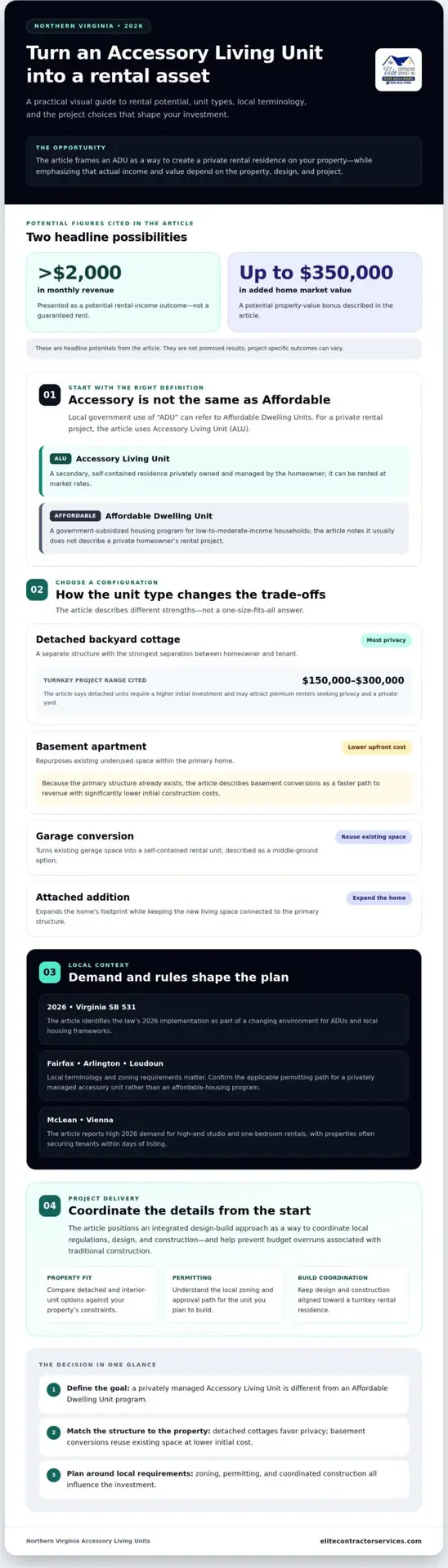
There is often significant confusion regarding terminology in our local counties. When you hear the term “ADU” in a government context, such as in Loudoun or Fairfax, it frequently refers to “Affordable Dwelling Units.” These are government-subsidized programs designed for low-to-moderate-income households and usually don’t apply to private homeowners looking to build on their own lots.
For your investment goals, you’re likely interested in an Accessory Living Unit (ALU). This is a secondary, self-contained residence on your property that you own and manage privately. Unlike subsidized programs, an ALU allows you to command market-rate rents. Identifying this distinction early is vital for your planning process, as it ensures you’re following the correct permitting path for a private rental asset rather than a restricted housing program.
The Economic Drivers of NOVA ADUs in 2026
The “Missing Middle” housing movement has gained massive momentum across Fairfax and Arlington counties. As traditional single-family homes become less attainable for many professionals, the demand for high-quality, smaller rental units has skyrocketed. This creates a perfect environment for homeowners to step in as boutique landlords. In 2026, rental demand for high-end studio and one-bedroom units in McLean and Vienna remains exceptionally high, with properties often securing tenants within days of listing. Working with a specialized Fairfax VA remodeling contractor ensures your unit is designed to attract these premium renters who value privacy and modern finishes over traditional apartment living.
Types of ADUs and Their Rental Revenue Potential
Choosing the right structure is the first step in maximizing your ADU for rental income potential Northern VA. While the Virginia ADU law provides a framework for these units, the specific type you build dictates your upfront investment and long-term yield. Every property in Northern Virginia has unique constraints, but the goal remains the same: creating a high-end space that commands top-tier rent.
Detached backyard cottages are often considered the gold standard in our region. These stand-alone structures offer the highest level of privacy for both the homeowner and the tenant. Because they function as entirely separate homes, they attract premium renters who are willing to pay more for the lack of shared walls and a private yard. If you’re looking for the fastest path to revenue, basement apartments are an excellent alternative. Since the primary structure already exists, you’re essentially repurposing underutilized square footage, which significantly lowers initial construction costs.
Garage conversions and attached additions offer a middle ground for many homeowners. A garage conversion can transform a dusty storage space into a modern, industrial-chic studio, while an attached addition allows for a seamless expansion of your home’s footprint. Both options provide the essential “missing middle” housing that is in high demand across Fairfax and Arlington counties.
Revenue Comparison: Detached vs. Interior Units
The financial profile of your project depends heavily on its configuration. Detached units typically require a higher initial investment, with most Northern Virginia projects ranging from $150,000 to $300,000 for a turnkey structure. However, the return is substantial. A well-executed detached unit can increase your home’s market value by $200,000 to $350,000. In affluent areas like Great Falls or Oakton, these units can command a 20-30% rental premium over interior units. Basement conversions, while offering slightly lower rent, often provide higher immediate cash flow because the entry price is much lower, typically ranging from $60,000 to $120,000.
Design Features That Command Higher Rent
Attracting long-term, reliable tenants requires more than just extra square footage. It’s about providing a high-end experience that justifies a premium price. A private, well-lit entrance is non-negotiable for maintaining boundaries and ensuring tenant security. Additionally, separate utility metering prevents future disputes and ensures your tenant is responsible for their own consumption. Looking at how residential specialists like Home Showings Property Management prepare and manage rental properties demonstrates how clear property standards and quality presentation protect long-term returns.
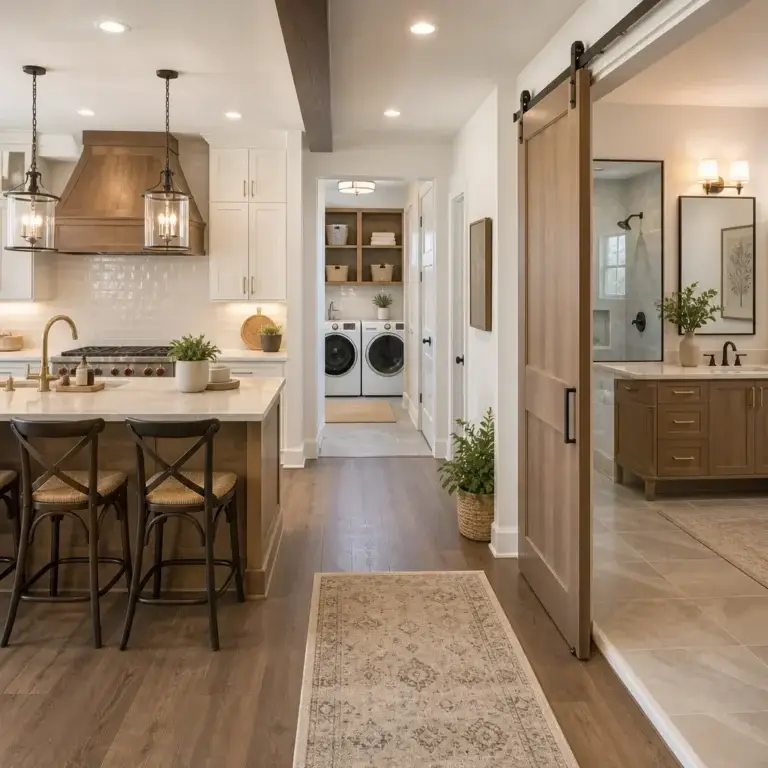
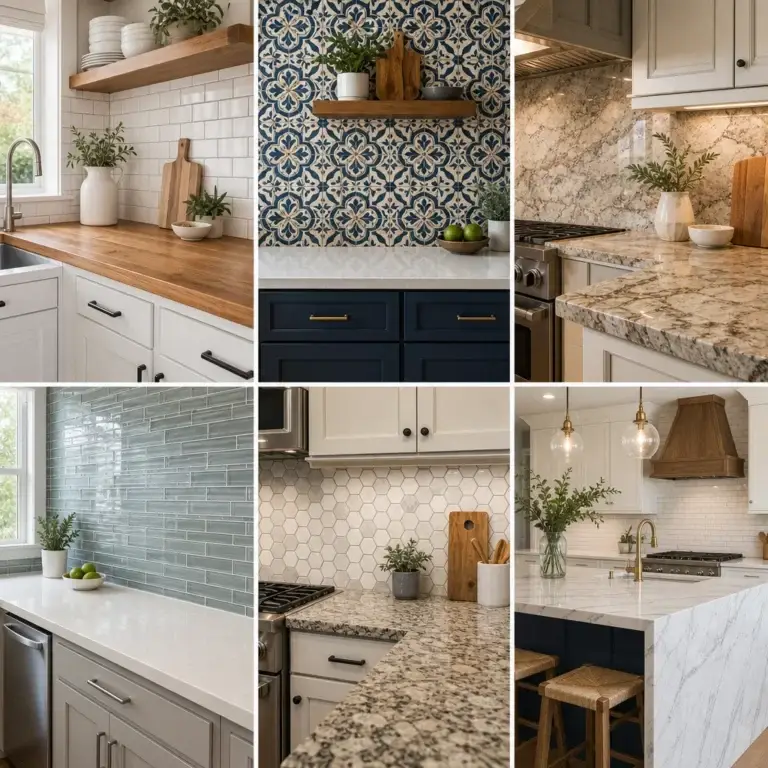
Luxury finishes are where you truly differentiate your property in a competitive market. Investing in high-quality kitchen design and remodeling pays for itself by attracting professionals who expect modern appliances, stone countertops, and ample storage. A spa-like bathroom and dedicated laundry facilities are also high-value features that keep occupancy rates high and turnover low. If you’re ready to explore how a custom home addition in Northern VA can transform your property’s financial future, we’re here to guide you through every design choice with calm competence.
Navigating Northern VA Zoning and Regulations
Zoning in Northern Virginia is notoriously fragmented. While recent state legislation aims to standardize rules, the current 2026 landscape still requires careful navigation at the county and city levels. Securing the full ADU for rental income potential Northern VA depends entirely on your ability to meet these local standards without triggering costly delays or legal setbacks. Our role is to provide the administrative clarity you need to move forward with confidence, ensuring your project meets every regulatory benchmark from day one.
Arlington County operates under the “Expanded Housing Options” (EHO) framework, which has opened new doors for property owners seeking to densify their lots responsibly. Meanwhile, the City of Alexandria maintains strict setbacks and height restrictions for detached units to preserve neighborhood character. Before you break ground, don’t forget your Homeowners Association (HOA). While state laws are becoming more permissive, early transparency with your HOA is vital. We recommend presenting professionally drafted plans to your board early to demonstrate that your new unit will be a high-end addition that maintains or even elevates neighborhood standards.
Fairfax County ALU Requirements
In Fairfax County, the terminology matters. Interior ALUs are limited to 800 square feet or 40% of the primary dwelling, whichever is less. If you’re eyeing a detached unit, you’ll generally need a lot of at least two acres and a special permit. Parking is another critical factor; typically, you must provide one off-street parking space for your tenant to satisfy county requirements. Partnering with a seasoned Fairfax VA remodeling contractor services ensures your design complies with these specific dimensions and parking mandates before you even submit your application.
Permitting and Administrative Clarity
The permitting process is often where the most significant project delays occur. Beyond standard building permits, you may need Health Department approval if your property is on a septic system. In 2026, Northern VA planning offices are managing high volumes, so expect a timeline of several months for full administrative approval. You shouldn’t have to manage this “paperwork nightmare” alone.
Professional oversight is essential to ensure your documentation is accurate and complete. This meticulous approach allows you to maximize the rental income potential of your new asset without the stress of constant bureaucratic back-and-forth. By handling the heavy lifting of permitting, we ensure your ADU for rental income potential Northern VA moves from the drafting table to reality as efficiently as possible.
Maximizing ROI: Design, Construction, and Management
Building a high-yield asset requires more than just following code. It demands a strategic approach to design that balances upfront costs with long-term durability and tenant appeal. To truly maximize your ADU for rental income potential Northern VA, you must look beyond the initial build and consider the unit’s lifecycle as a professional rental property. This means selecting finishes that feel luxurious to a prospective tenant but are resilient enough to handle frequent turnover without requiring constant maintenance. Homeowners preparing for ongoing landlord responsibilities can also consult full-service management resources like tbmpropmanagement.com for insight into tenant placement and day-to-day property operations.
Your property’s appraisal also stands to benefit significantly from this addition. A professionally constructed 700-square-foot unit can increase your home’s market value by $200,000 to $350,000 in the 2026 Northern Virginia market. This “property value bonus” provides a secondary layer of wealth building that often exceeds the initial construction investment. When you factor in the high demand for private housing in Fairfax and Arlington, the financial case for a well-designed ALU becomes exceptionally clear.
Utility management is another critical factor in your ROI. While shared systems might seem cheaper during construction, separate metering for electricity and water simplifies long-term management. It places the responsibility for consumption directly on the tenant, which protects your margins and prevents disputes. If you’re concerned about the initial investment, reviewing a home addition cost Northern Virginia guide can help you set a realistic 2026 budget for these essential infrastructure choices.
Financial Modeling for Your ALU
A high-end Accessory Living Unit in Northern Virginia typically delivers a net annual yield of approximately 10% to 12%, allowing many homeowners to reach a full payback on their investment within six to eight years. Beyond the monthly rent, you should consider the local tax implications. While property improvements will increase your assessed value, the rental income and certain depreciation benefits can often offset the increase in property taxes. We recommend consulting with a tax professional to see how your specific project fits into your broader wealth-building strategy.
Minimizing Disruption During Construction
The biggest fear for most homeowners is the “construction nightmare” that turns their primary residence into a chaotic job site. Our approach centers on calm competence and meticulous site management. We employ rigorous dust mitigation and noise control strategies to ensure your daily life remains as normal as possible, even during major structural phases. Efficient scheduling is also a priority. By integrating the design and construction phases, we reduce downtime and get your unit on the rental market faster. If you’re ready to build a sophisticated financial asset without the stress, consult with our design-build experts to start your project with a partner who values your peace of mind.
The Design-Build Advantage for Your Northern VA ADU Project
The traditional construction model often leaves homeowners caught between an architect’s vision and a contractor’s budget. This fragmented approach frequently leads to “design creep,” where beautiful plans are drafted only to be deemed unbuildable or prohibitively expensive during the bidding phase. For a project as complex as an Accessory Living Unit, this disconnect is more than just a nuisance; it’s a financial risk. Successfully leveraging an ADU for rental income potential Northern VA requires a methodology where the design and construction teams work as a single, cohesive unit from the very first sketch.
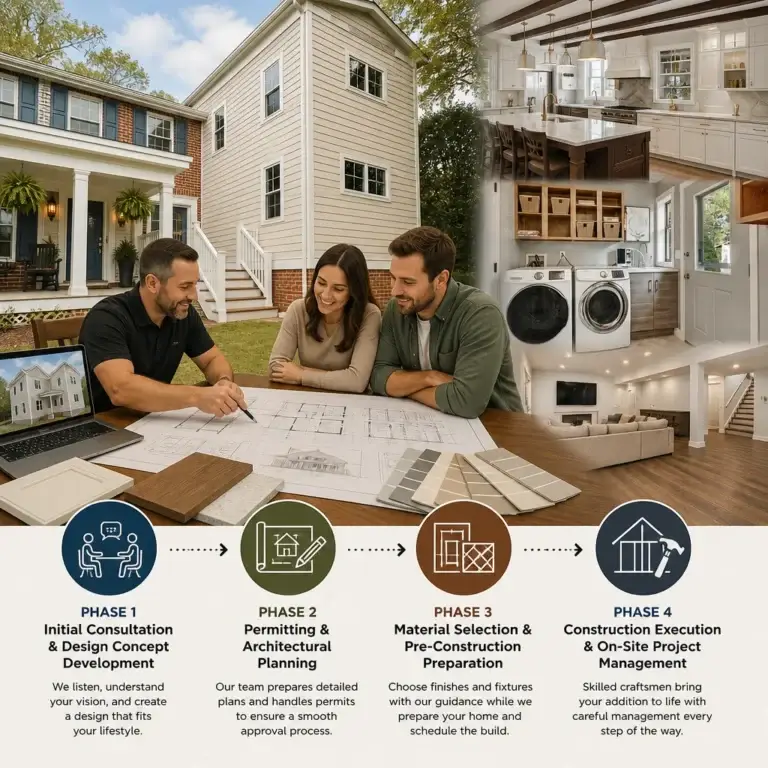
Our design-build model provides a single point of accountability that protects your investment. By integrating architectural expertise with on-the-ground construction knowledge, we ensure that every design choice is grounded in local zoning reality and your specific budget constraints. You won’t have to act as a middleman between competing professionals. Instead, you’ll experience a collaborative journey with a partner who prioritizes your peace of mind and the long-term viability of your rental asset. Realizing the full ADU for rental income potential Northern VA depends on this meticulous oversight, ensuring your project moves from concept to completion without the common industry failures of delays and mismanagement.
Predictable Results and Financial Clarity
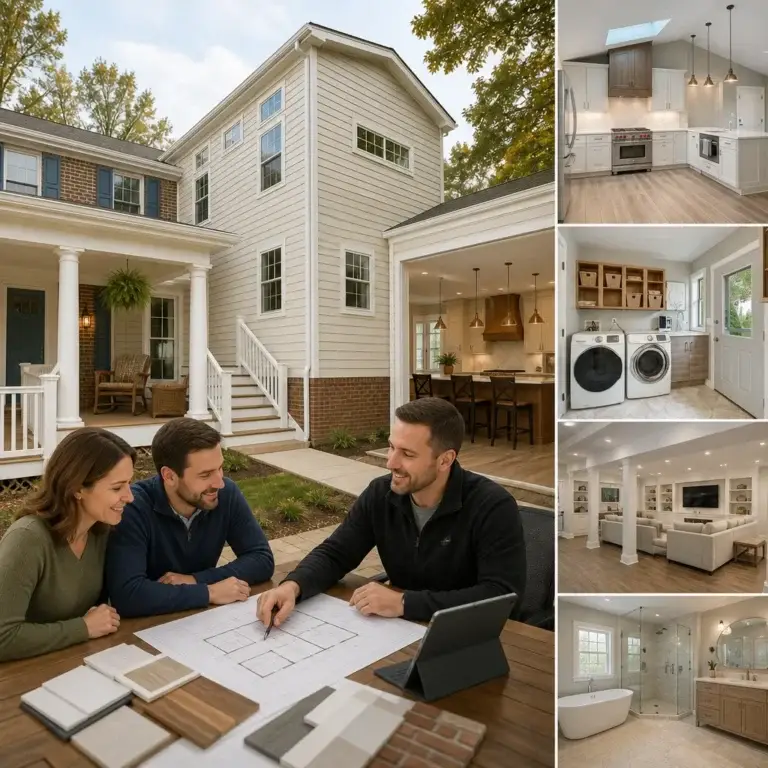
We’ve developed a multi-step workflow designed to eliminate the anxiety of “surprise” costs. Our process begins with a deep dive into your property’s specific constraints, translating your goals into a code-compliant, rentable reality. This transparent methodology is why homeowners increasingly look for top design-build firms near me when planning high-stakes investments. We provide formal documentation and clear pricing at every stage, allowing you to make informed decisions about finishes and layouts that will attract premium tenants. Our goal is to deliver a turnkey investment that starts generating revenue the moment we hand over the keys.
Next Steps: Planning Your 2026 ADU Project
Your journey toward becoming a successful Northern Virginia landlord starts with a feasibility consultation. Every lot is different, and identifying your property’s unique potential requires a seasoned eye for both design and local regulations. We’ll help you determine whether a detached cottage, a basement conversion, or an attached addition is the most strategic path for your land. Whether you’re located in Fairfax, Alexandria, or other home additions Northern VA service areas, we’re ready to provide the calm competence your project deserves. Contact us today to begin the transformation of your property into a high-yield financial asset.
Transform Your Property into a High-Yield Asset
The 2026 housing market offers a unique opening for homeowners to secure their financial futures. By understanding the critical distinction between private ALUs and subsidized housing, you can leverage the full ADU for rental income potential Northern VA. Success hinges on more than just square footage; it requires navigating complex local setbacks and choosing a design-build partner who provides a single point of accountability. You’ve seen how the right finishes and strategic utility planning can turn a backyard structure into a premium residence that commands top-tier market rents while boosting your home’s total value.
We’re here to ensure your journey is marked by tranquility and predictable results. Our high-end Northern VA portfolio and specialized design-build process are designed to eliminate the anxiety of large-scale remodeling. We handle the administrative clarity and disruption control so you can focus on the long-term wealth your property will generate. Don’t let the complexity of zoning or the fear of budget overruns hold you back from a turnkey investment. Schedule your Northern VA ALU consultation with Elite Contractor Services today and take the first step toward a sophisticated, high-yield addition to your home. Your property’s untapped potential is waiting.
Frequently Asked Questions
Can I build an ADU for rental income anywhere in Northern Virginia?
Eligibility depends on your specific county and lot size as of early 2026. While the new state law SB 531 will standardize ADU rights by July 2027, current regulations in Fairfax County require at least two acres for a detached unit. Arlington and Alexandria have more flexible density frameworks, but you must still verify your specific zoning district and any existing HOA restrictions before planning your project.
How much does it cost to build a detached ADU in Fairfax County in 2026?
Industry data for Northern Virginia shows that a turnkey detached unit typically ranges from $150,000 to $300,000 depending on square footage and finish quality. This investment covers the entire lifecycle of the project, including architectural plans, structural engineering, and the necessary permit fees. Choosing a high-end finish is often the best strategy for maximizing the ADU for rental income potential Northern VA, as it attracts long-term, professional tenants.
What is the maximum size allowed for an Accessory Living Unit in Arlington?
Arlington’s regulations are designed to ensure the accessory unit remains secondary to the primary residence. Under the Expanded Housing Options framework, the size is typically capped to maintain the character of the neighborhood. In nearby Fairfax, interior units are limited to 800 square feet or 40% of the main dwelling’s size, whichever is less, and Arlington follows similar principles of scale and proportion.
Do I need a separate entrance for a basement rental unit in Alexandria?
Yes, a separate, private entrance is a standard requirement for legal rental units across Alexandria and the broader Northern Virginia area. Beyond legal compliance, an independent entrance is vital for tenant privacy and safety. It also allows you to command a higher monthly rent by providing a self-contained living experience that feels like a private home rather than a shared basement.
How does adding an ALU affect my property taxes in Northern VA?
Your property taxes will likely increase because the addition of a habitable, high-end structure raises the overall assessed value of your property. However, many homeowners find that the monthly rental income, which averages between $1,400 and $2,000 in Fairfax County, significantly outweighs the incremental tax increase. You’re essentially creating a revenue-generating asset that pays for its own overhead while building long-term equity.
Can I rent out my ADU on Airbnb or short-term rental platforms?
Short-term rental regulations are strictly enforced in Northern Virginia and often require the property owner to reside in the primary dwelling. Some jurisdictions require a specific administrative permit for rentals shorter than 30 days. If your goal is maximizing the ADU for rental income potential Northern VA, long-term leases are often more predictable and involve less administrative oversight than short-term platforms.
How long does the design-build process take for a backyard cottage?
The entire process, from initial feasibility to final inspection, typically takes several months. In 2026, Northern Virginia planning offices are experiencing high volumes, so the permitting phase alone can take three to five months. The design-build model streamlines this timeline by managing the architectural and construction phases concurrently, which eliminates the downtime often found in traditional “architect-then-contractor” workflows.
Will an ADU increase my property value more than a traditional home addition?
An ADU often provides a superior return on investment because it functions as an independent income stream. While a traditional home addition increases square footage, a well-executed 700-square-foot ADU can boost your market value by $200,000 to $350,000. It appeals to a wider range of future buyers, including investors and multigenerational families, making it a more versatile asset than a simple bedroom expansion.