Did you know that a high-end finished basement in Northern Virginia can recoup up to 75% of its cost while cutting your home’s time on the market by an average of 14 days? It’s natural to feel a sense of anxiety when you see national price averages that don’t reflect the reality of our local market. You want a space that adds genuine value to your lifestyle, but the fear of low-ball estimates and unexpected change orders can make the process feel daunting. Understanding the actual basement finishing cost per square foot Virginia homeowners face in 2026 is the first step toward a predictable and successful renovation.
In this guide, you’ll discover the specific variables that drive investment levels in Northern Virginia, including the latest 2021 VUSBC egress requirements and premium material trends like quartz and waterproof flooring. We’ll provide a clear breakdown of what separates a standard project from a high-end design-build investment. You’ll gain a comprehensive look at how local factors like permit fees and structural codes impact your bottom line. By the end, you’ll have the confidence to choose a partner who delivers a meticulous, high-quality result on time and within your financial plan.
Key Takeaways
- Learn the realistic basement finishing cost per square foot Virginia residents can expect in 2026, including the differences between basic finishes and high-end luxury builds.
- Understand how Northern Virginia’s specific building codes and permit fees in counties like Fairfax and Arlington directly influence your project’s total investment.
- Identify the high-impact luxury add-ons that maximize your property value and lifestyle, from custom kitchenettes to professional home theaters.
- Navigate the 2026 Virginia Egress Code requirements to ensure your new living area meets all legal safety standards for residential occupancy.
- Discover how a collaborative design-build approach provides the mental tranquility and financial predictability needed to avoid costly mid-construction changes.
Understanding Basement Finishing Cost Per Square Foot in Virginia
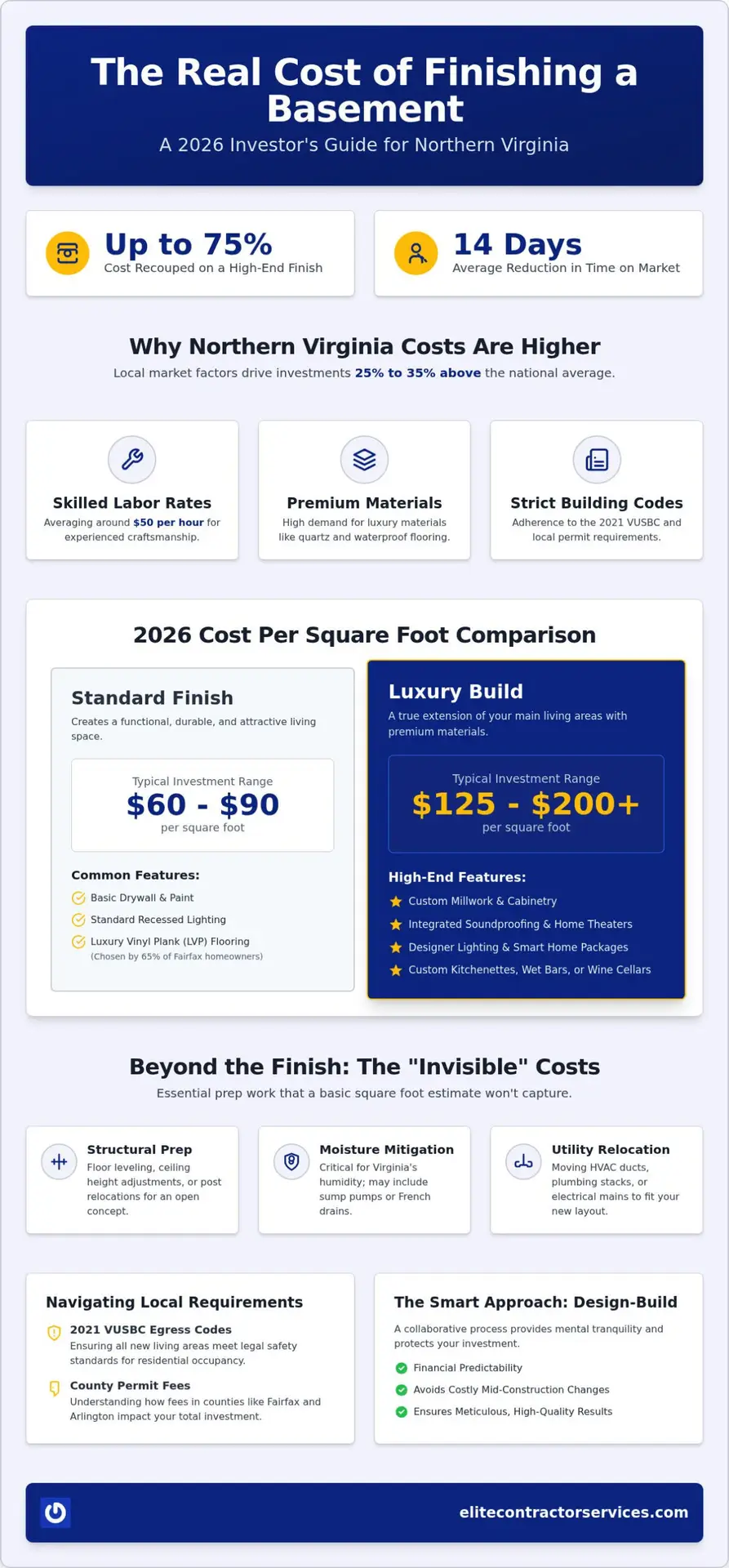
Starting a renovation project often begins with a single number. However, calculating the basement finishing cost per square foot Virginia homeowners should expect involves more than a simple multiplication of length and width. In our region, particularly Northern Virginia, costs tend to exceed national averages by 25% to 35%. This is driven by a combination of high skilled labor rates, which currently average around $50 per hour, premium material choices, and the rigorous administrative requirements of the 2021 Virginia Uniform Statewide Building Code. Understanding Basement Finishing requires first distinguishing between finishing an empty concrete shell and remodeling an existing space. While finishing creates new livable square footage from scratch, remodeling updates an area that was previously completed. Both require a meticulous eye for detail to ensure the final result matches the high standards of homes in McLean or Great Falls.
Your investment is generally supported by three main pillars: labor, high-end materials, and administrative fees. Because of the complexity involved in below-grade construction, a square foot estimate is a helpful starting point but rarely a final quote. Factors such as the age of your home, the condition of the existing slab, and your specific lifestyle goals will eventually refine that number into a predictable project budget.
Standard vs. Luxury: Defining the Finish Quality
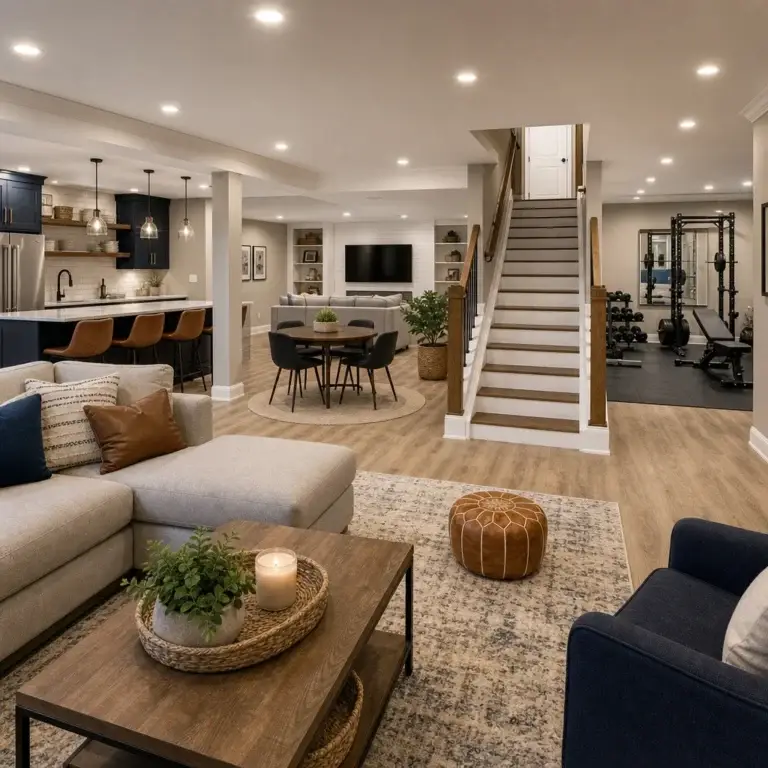
The quality of your materials can swing the final price by 40% or more. A standard finish in the local market usually involves basic drywall, standard recessed lighting, and durable flooring like Luxury Vinyl Plank (LVP), which 65% of Fairfax homeowners chose in 2026. A luxury build, however, transitions the space into a true extension of your upper floors. This level of investment includes custom millwork, integrated soundproofing for home theaters, and designer lighting packages. These high-end choices transform a basement from a simple storage area into a sophisticated retreat that feels intentional and seamless.
The “Invisible” Costs: Prep and Structural Work
Before the first piece of drywall is hung, several invisible factors impact your budget. Older homes in areas like Arlington often require floor leveling or ceiling height adjustments to meet modern comfort standards. Moisture mitigation is another critical pillar. Installing French drains or sump pumps is essential for long-term peace of mind, especially given Virginia’s humidity. Additionally, moving existing HVAC ducts, plumbing stacks, or electrical mains to create an open floor plan adds complexity that a basic square foot estimate won’t capture. Working with an experienced Fairfax VA remodeling contractor ensures these structural nuances are identified during the design phase rather than as costly surprises during construction.
2026 Cost Estimates: Northern Virginia Basement Price Ranges
Navigating the financial landscape of a home renovation requires transparency and local expertise. In 2026, the basement finishing cost per square foot Virginia homeowners encounter reflects a sophisticated market with high expectations for quality. For a standard finish, you can expect an investment range between $60 and $90 per square foot. If your vision includes the premium features we discussed earlier, such as custom millwork or integrated home theaters, a luxury finish typically starts at $125 and can exceed $200 per square foot. These figures represent the reality of the Northern Virginia market, where the emphasis on craftsmanship and long-term value is paramount.
These figures are influenced by a skilled labor market where rates currently hover around $50 per hour. While national trends provide a baseline, Remodeling Magazine’s Cost vs. Value Report highlights how regional differences, especially in the Mid-Atlantic, significantly impact project totals. In 2026, material price volatility remains a factor. Supply chain shifts and the demand for specialized components, such as quartz countertops or advanced climate control systems, drive costs upward. This makes the predictability of a professional design-build partnership more valuable than ever, as it protects you from the financial mismanagement common in traditional bidding models.
Basement Size and Cost Scaling
It’s helpful to understand how the total footprint of your project changes the math. Small basements under 500 square feet often carry a higher basement finishing cost per square foot Virginia homeowners might find surprising. This happens because fixed costs, such as permits, mobilization, and essential utility work, are spread over a smaller area. Conversely, larger projects of 1,000 square feet or more allow for better economy of scale. You might find that adding an open-concept lounge alongside a guest suite is more cost-efficient than building multiple small, partitioned rooms that require more framing, electrical runs, and finishing labor.
Regional Variations Within Virginia
Where you live in the Commonwealth matters. In high-density urban centers like Arlington and Alexandria, logistical challenges add a premium to the bid. Restricted street parking for crews and tighter access for material deliveries require more time and coordination. In contrast, estates in McLean, Great Falls, and Vienna often demand a level of architectural detail and finish consistency that aligns with the rest of the home’s luxury profile. Whether you are in a historic district or a new development, our team understands the nuances of each neighborhood. You can explore our Northern Virginia service areas to see how we bring this local expertise to your specific community.
Luxury Add-ons and Their Impact on Your Investment
In the Northern Virginia market, finishing a basement is rarely just about adding square footage; it’s about creating a bespoke environment that mirrors the quality of your main living levels. While the basement finishing cost per square foot Virginia homeowners invest might increase with high-end features, the return on investment (ROI) remains remarkably strong. Current data indicates that a finished basement in our region can recoup between 70% and 75% of its cost in the real estate market. For those prioritizing a professional home office, the ROI is equally impressive at 70%. These additions do more than enhance your daily lifestyle; they serve as a strategic financial move that can reduce your home’s time on the market by an average of 14 days.
Beyond the structural basics, 2026 trends show a significant lean toward smart home integration and professional-grade home theaters. These systems require dedicated electrical circuits and advanced climate control, such as ductless mini-splits, to manage the specific humidity levels of our region. By addressing these technical requirements during the design phase, you ensure your investment provides both immediate enjoyment and long-term peace of mind.
The Cost of Basement Wet Bars and Kitchenettes
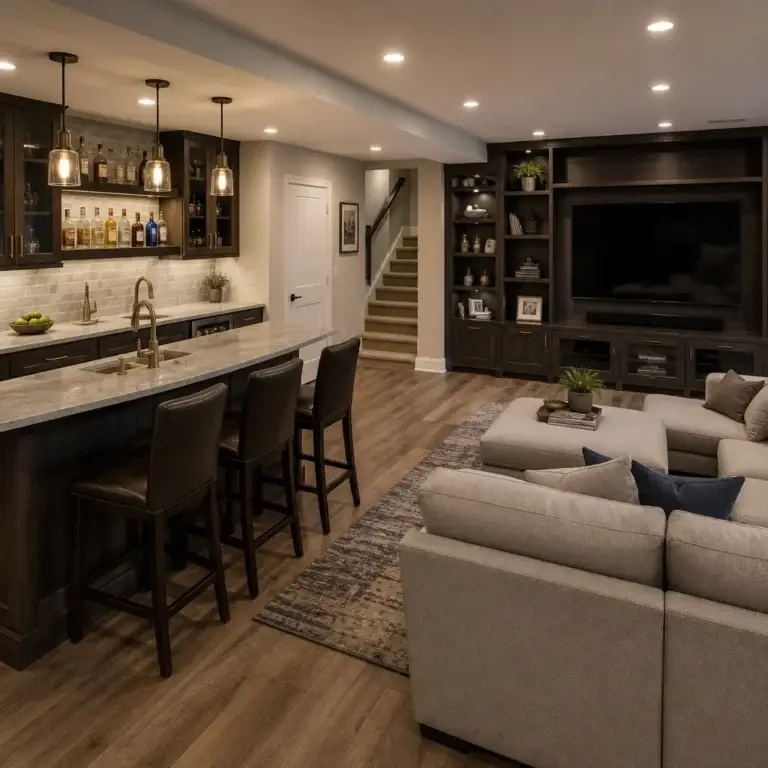
Integrating a wet bar or kitchenette is a hallmark of a luxury build. In 2026, quartz remains the dominant choice for basement bars, appearing in 92% of high-end projects in our area. This level of finish often requires specialized infrastructure, such as ejector pumps to handle plumbing lines located below the sewer main. We often guide clients through the choice between custom and semi-custom cabinetry. Custom millwork provides a seamless look that matches the home’s existing architecture perfectly. For those envisioning a more robust culinary space, our expertise in Luxury Kitchen Design & Remodeling ensures that your basement kitchenette includes professional-grade appliances, from wine coolers to integrated dishwashers, without compromising on aesthetics or floor plan flow.
Basement Bathrooms: A Critical Value Add
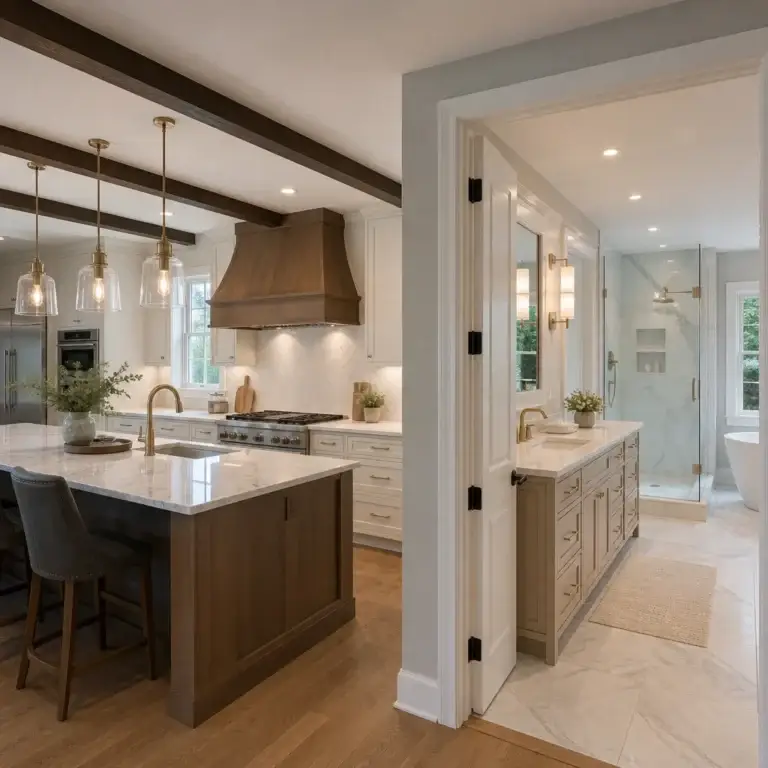
Adding a full bathroom is perhaps the most significant functional upgrade you can make to a below-grade space. In Fairfax County, this typically involves trenching through the existing concrete slab to install new plumbing lines, a process that requires meticulous planning and professional oversight. While a half-bath provides basic convenience, a luxury spa bath featuring premium tile and high-end fixtures transforms the basement into a true guest suite. These choices are what elevate the basement finishing cost per square foot Virginia residents plan for, turning a utility space into a high-value destination within the home. Selecting moisture-resistant materials and high-efficiency ventilation is essential to maintaining the integrity of this investment over time.
Local Virginia Requirements: Permits, Egress, and Codes
Adhering to local building codes is the most critical step in protecting your investment and your family’s safety. In Northern Virginia, compliance with the 2021 Virginia Uniform Statewide Building Code (VUSBC) became mandatory for all new permit applications after January 17, 2025. These regulations aren’t just red tape; they’re the standard that ensures your new living space is legally recognized and structurally sound. When calculating the basement finishing cost per square foot Virginia residents should expect, accounting for these administrative and safety requirements early prevents the stress of failed inspections or future legal complications during a home sale.
Beyond structural safety, environmental health is a primary concern in our region. Radon testing and mitigation are standard requirements for many Northern Virginia projects. If elevated levels are detected, installing a mitigation system is a necessary step to ensure long-term air quality. Additionally, bringing older wiring up to the current International Residential Code (IRC) often requires upgrading to a 200-amp service. This electrical modernization typically costs between $2,500 and $4,000 in Fairfax County, providing the necessary capacity for modern home theaters and high-end kitchenettes.
Egress Windows and Safety Exits
If you plan to include a legal bedroom or a dedicated home office, the Virginia Egress Code is non-negotiable. An egress window must provide a minimum net clear opening of 5.7 square feet, with a sill height no more than 44 inches from the floor. For below-grade openings, a window well with at least 9 square feet of horizontal area is required. Installing a code-compliant egress window system in 2026 typically ranges from $5,000 to $15,000 depending on excavation needs. For homeowners considering more extensive structural changes, such as converting a standard basement into a walk-out, our Home Addition Services in Northern VA provide the specialized engineering required to manage these complex transitions safely.
Navigating the Virginia Permitting Process
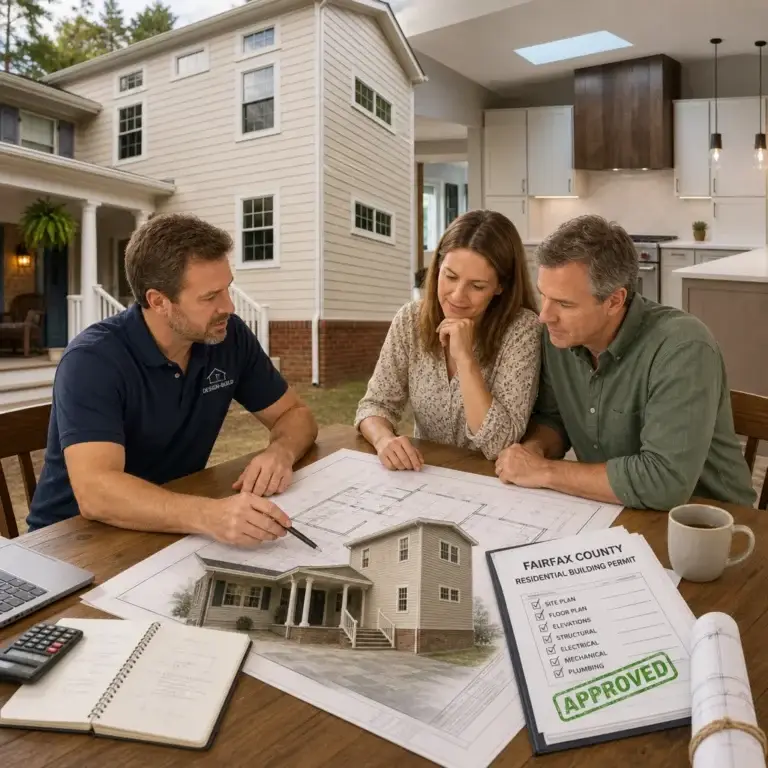
The permitting landscape varies significantly between jurisdictions. In 2026, permit fees for a standard 1,000-square-foot basement in Fairfax County typically range from $950 to $2,800. Arlington County follows a similarly rigorous fee structure and review process. You should plan for an initial plan approval timeline of 35 to 55 days. While it’s tempting to bypass these steps, unpermitted work is a significant financial risk. It can lead to daily fines, the requirement to tear out finished work for inspection, and major hurdles during property appraisals. A professional design-build firm manages this entire process for you, coordinating multiple inspections to keep the project on schedule and ensuring your basement finishing cost per square foot Virginia stays predictable.
Ensuring your project meets every local requirement requires a partner who understands the nuances of Northern Virginia’s regulatory environment. You can rely on our expertise as a dedicated Fairfax VA remodeling contractor to handle every permit and inspection with meticulous care.
Why Design-Build is the Most Predictable Way to Manage Costs
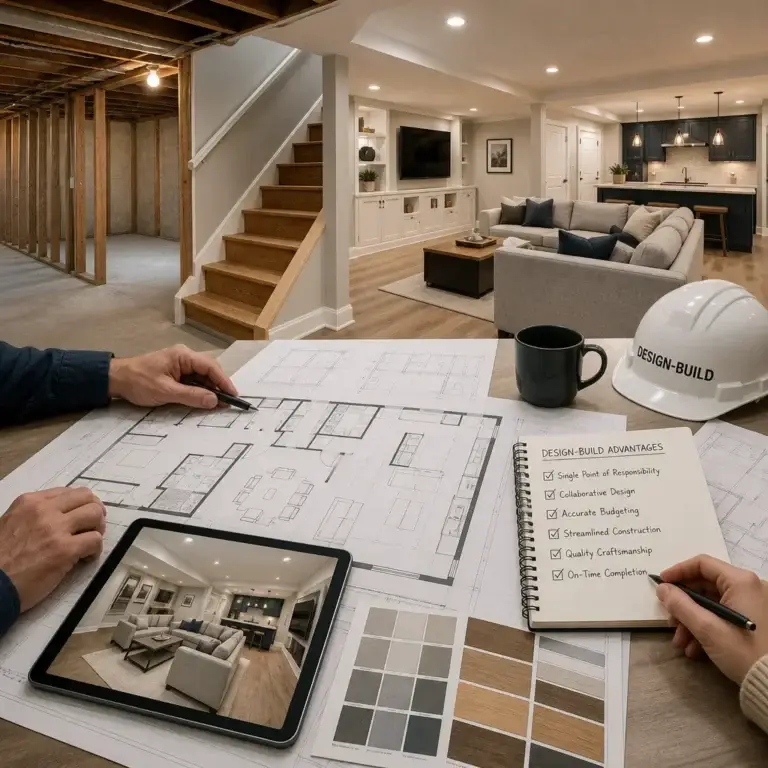
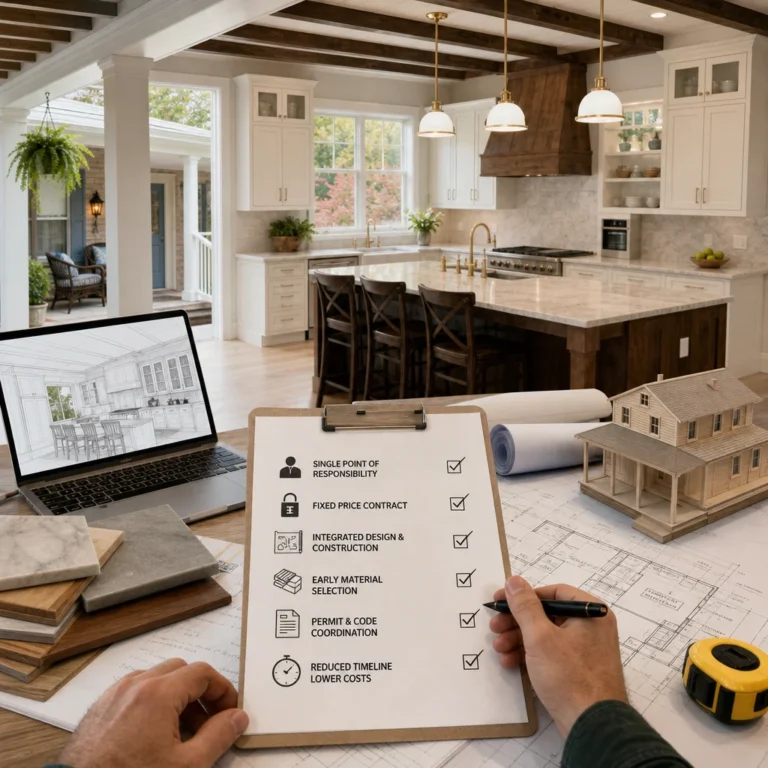
Traditional remodeling often follows a “Bid-Build” model where you hire an architect to design a space and then seek out contractors to build it. This separation frequently creates a disconnect between the vision and the actual construction budget. When these two phases are siloed, homeowners often face a basement finishing cost per square foot Virginia contractors can’t honor because the design didn’t account for structural realities or current material pricing. The design-build model serves as the direct antidote to this common industry failure. By integrating design and construction under one roof, we ensure that every architectural choice is grounded in financial reality from the very first sketch.
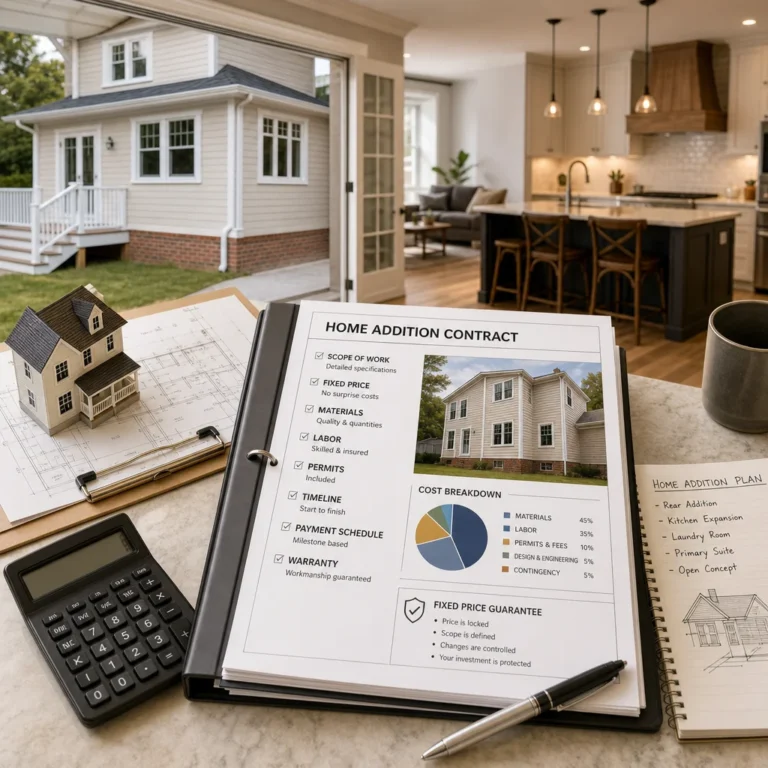
Early-stage collaboration prevents the expensive mid-construction changes that lead to anxiety and budget overruns. Instead of working with a loose estimate, you move toward a fixed-price contract based on detailed specifications. This transparency provides the mental tranquility you need for a large-scale home improvement project. Whether you are in McLean, Alexandria, or any of our other Elite Contractor Service Areas, this methodical approach ensures that your investment is managed with professional oversight and administrative clarity.
Eliminating the “Contractor Anxiety” through Collaboration
Having a single point of contact for both design and construction simplifies the entire journey. You don’t have to act as a mediator between an architect and a builder; instead, you have a dependable partner who handles every detail. We focus on minimizing disruption for your family, ensuring that the construction phase is as smooth and predictable as the planning phase. This collaborative relationship elevates the project beyond a simple transaction, delivering high-end results that align perfectly with the sophisticated Northern Virginia lifestyle.
Final Steps: Planning Your 2026 Basement Project
As you begin your budgeting process, we recommend setting aside a 10% contingency fund. While our design-build process is designed to minimize surprises, this buffer provides extra security for any personal design changes you might decide on during the build. To ensure your project remains on your desired timeline, it’s wise to schedule your consultation early to beat the seasonal remodeling rush. A meticulous plan is the best way to keep your basement finishing cost per square foot Virginia investment within your financial constraints. When you’re ready to transform your home with a partner who values excellence and reliability, Schedule a Consultation with Elite Contractor Services to begin your supportive journey toward a beautiful, finished basement.
Transforming Your Virginia Home with Confidence
Finishing your basement is an investment that yields significant lifestyle and financial rewards. We’ve explored how navigating the basement finishing cost per square foot Virginia homeowners face requires a balance of high-end aesthetics and strict adherence to local building codes. From ensuring legal egress compliance to selecting premium finishes that mirror your main living levels, every detail matters. The key to a successful project is moving away from the uncertainty of traditional bidding and toward a collaborative, predictable model.
Our team specializes in high-end Northern Virginia homes, providing the meticulous planning and organizational oversight needed to eliminate the stress of remodeling. With our design-build approach, you’ll enjoy transparent pricing and predictable timelines that respect your family’s daily life. You deserve a partner who understands your vision and is fully equipped to deliver excellence without logistical disruptions. We’re here to guide you through every phase of this journey with calm competence and professional care.
Start Your Luxury Basement Transformation with Elite Contractor Services and take the first step toward a space that truly enhances your home’s value and your quality of life.
Frequently Asked Questions
What is the average basement finishing cost per square foot in Virginia for 2026?
The basement finishing cost per square foot Virginia homeowners encounter in 2026 typically ranges from $60 to $90 for standard finishes and $125 to $200 or more for luxury builds. These local rates reflect Northern Virginia’s higher labor costs and the stringent requirements of the 2021 Virginia Uniform Statewide Building Code. Your final investment depends on material selections and the complexity of your structural needs.
Does finishing a basement increase my property taxes in Northern Virginia?
Yes, finishing your basement will likely increase your property taxes because it adds livable square footage and increases your home’s assessed value. Local assessors in Fairfax and Arlington counties view finished basements as a significant improvement to the property. While this results in a higher annual tax bill, the increase is usually proportional to the substantial equity gain you achieve through the renovation.
How much does an egress window add to the total basement cost?
Installing a code-compliant egress window system generally adds between $5,000 and $15,000 to your total project investment. This cost includes excavation, structural reinforcement, the window unit, and the required window well. It’s a mandatory safety expense for any space intended for sleeping or as a legal home office under current Virginia building codes.
How long does a typical basement finishing project take in Fairfax County?
A typical basement finishing project in Fairfax County takes approximately 8 to 12 weeks of active construction after permit approval. You should also account for the initial 35 to 55 days required for the county’s plan review process. Our design-build model streamlines this timeline by coordinating inspections and material deliveries in advance to prevent common logistical delays.
Can I finish my basement in stages to manage the cost?
You can finish a basement in stages, but it’s often less cost-effective than completing the project at once. Segmenting the work requires multiple mobilizations of crews and separate permit applications, which increases administrative fees and labor costs over time. We recommend completing all structural, plumbing, and electrical work in the first phase to avoid the need to tear out finished walls later.
What is the difference between a basement remodel and finishing?
Basement finishing refers to transforming a raw, unfinished concrete shell into a livable space with walls, flooring, and utilities. A basement remodel involves updating or reconfiguring a space that was already finished in the past. Finishing usually requires more initial structural work and moisture mitigation, while remodeling focuses on aesthetic upgrades and layout changes to an existing floor plan.
Is a permit required for basement finishing in Arlington, VA?
Yes, a building permit is strictly required for basement finishing in Arlington, VA. This ensures all electrical, plumbing, and structural work meets the latest safety standards and building codes. Proceeding without a permit can lead to significant legal issues, daily fines, and complications when you eventually try to sell your home, as unpermitted work is often flagged during the appraisal process.
What is the ROI of finishing a basement in the Northern Virginia real estate market?
The return on investment for a finished basement in the Northern Virginia market is currently estimated between 70% and 75%. Beyond the financial recoupment, a high-quality finish makes your home more competitive, often reducing time on the market by an average of 14 days. Dedicated spaces like home offices are particularly valuable, yielding a consistent 70% ROI in our region’s post-remote-work economy.