Permitted hours aren’t a blanket pass for disruptive construction noise. Residential construction is typically restricted to 9 a.m. through 5 p.m., but local ordinances can set different hours and may also regulate noise levels or impose other conditions. When dealing with construction noise, the key is to understand both the schedule and the rules that apply where the work is happening.
It’s understandable to expect work during approved hours to be acceptable, especially when the noise affects your home or routine. But timing alone doesn’t determine whether construction noise complies with local requirements.
This guide explains how local construction-hour and noise rules can differ, what to document when noise becomes a problem, and which practical measures can reduce sound at its source or along its path. It also covers how thoughtful planning can limit disruption during a home remodeling project.
Key Takeaways
- Work taking place during permitted hours may still be subject to local noise limits or other conditions. Learn which local rules shape the answer.
- Keep a clear record of disruptive noise, including when it occurs, how long it lasts, and which equipment is operating.
- Reduce noise by addressing it at the source and along its path, with measures such as equipment placement, barriers, and sound-absorbing materials.
- Quieter equipment choices, routine maintenance, and adjusted work practices can help limit construction noise.
- Local requirements and project conditions guide whether barriers, schedule changes, or sound monitoring are appropriate.
1. Does construction being within permitted hours mean the noise is automatically acceptable?
No. Permitted hours establish when certain work may take place, but they don’t automatically make every noise level or work practice acceptable. Local ordinances may set noise limits or other conditions, so the applicable schedule depends on the municipality and project.
Residential construction is typically restricted to 9 a.m. through 5 p.m., but local ordinances can set different hours. Some municipalities also impose conditions on early-morning or late-evening work, or require approval for construction on Sundays or holidays. Check the rules for the property’s location rather than assuming a schedule used elsewhere applies.
Hours are only part of the question. Builders should account for local requirements governing construction schedules, noise levels, and noise-reduction measures. Work within an allowed time window may still have to meet other requirements. A resident’s complaint alone doesn’t establish that construction exceeded a legal noise limit, but it can identify a concern worth documenting.
To limit repeated disruption, group especially noisy tasks into planned work periods instead of scattering them throughout the schedule. For example, coordinating loud cutting or drilling with other noisy work can avoid separate bursts on different days. Adjust the plan when local requirements, site conditions, or the work itself call for a quieter method or different timing.
For extended operations, divide the schedule by impact. A plan for a 24/7 project can place full operations in unrestricted daytime hours, modify work in the evening, and reserve minimal-impact tasks for overnight. This approach recognizes that an allowed operating period doesn’t make every activity equally suitable throughout it.
When hours change, document the revised work windows, the reason for the adjustment, and the tasks being moved. A dated schedule makes it easier to communicate expected noisy periods and compare actual work with the plan. Residents can also log dates, times, duration, decibel readings, and equipment in use. Official measurements should follow the method required by the local authority.
For temporary relief, well-fitting earplugs or noise-canceling headphones may help during frequent or especially loud work. The best option depends on comfort and fit; neither replaces compliance with local rules or workplace protections.
Prolonged exposure to loud construction noise can cause noise-induced hearing loss, which may be irreversible. Construction noise can also contribute to anxiety or difficulty concentrating. The National Institute for Occupational Safety and Health (NIOSH) advises limiting workers’ average noise exposure to 85 decibels (dBA) over an eight-hour shift. That worker-exposure guidance is distinct from local rules governing noise heard by nearby residents.
2. Noise controls at the source and along sound paths
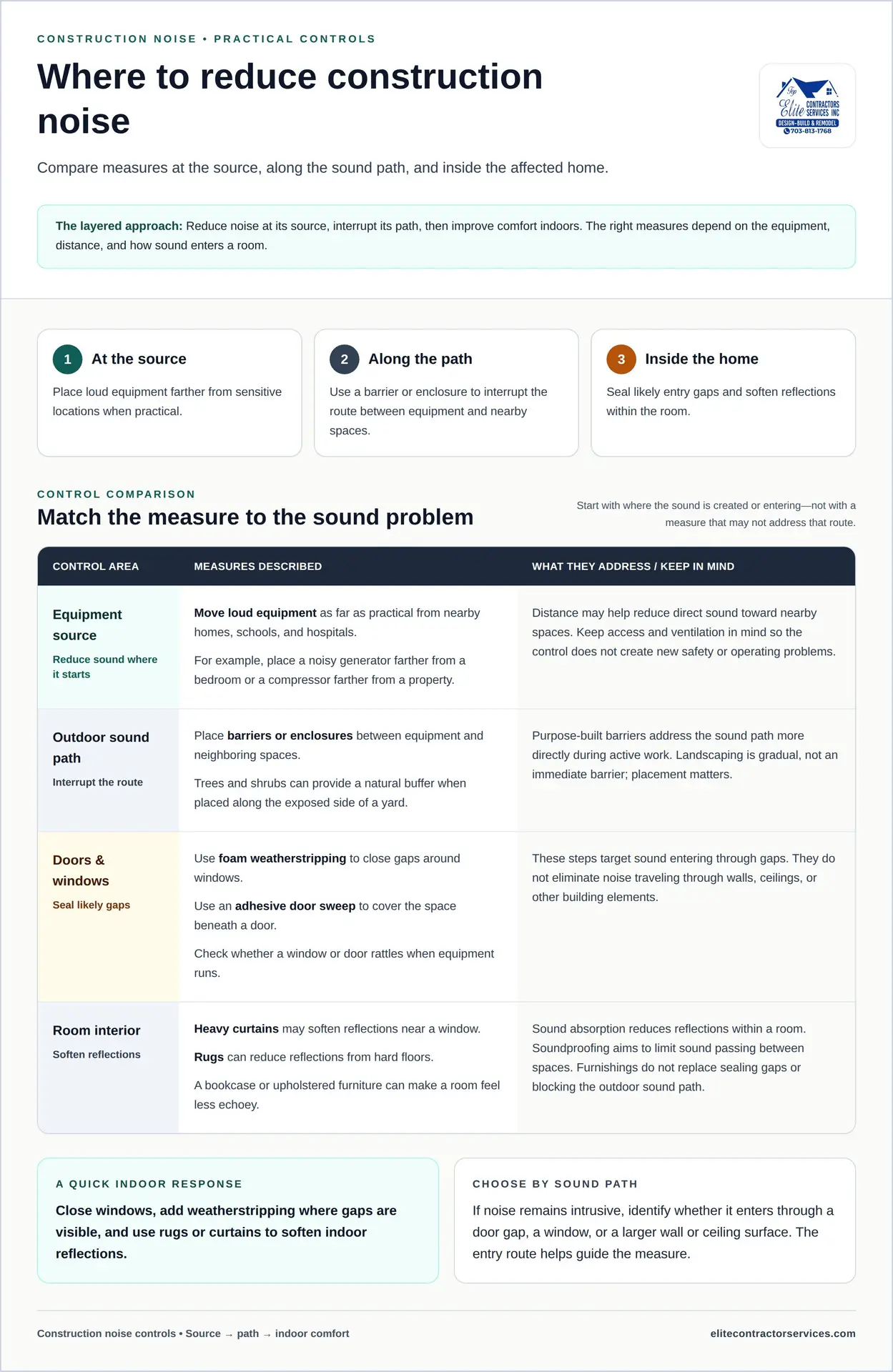
Construction noise can be addressed at its source, along its route, or inside the affected home. The right measures depend on the equipment, distance, and how sound enters a room. For example, moving a noisy generator farther from a bedroom may help before adding indoor materials. Combining practical controls can be more effective than relying on a single measure.
At the work area, position loud equipment as far as practical from sensitive locations, such as nearby homes, schools, and hospitals. A compressor placed farther from a property may send less direct sound toward its windows. Barriers or enclosures can also interrupt the path between equipment and neighboring spaces. Keep access and ventilation in mind so controls don’t create new safety or operating problems.
At home, start with likely entry points. Foam weatherstripping can close gaps around windows, while an adhesive door sweep can cover the space beneath a door. Check whether a window or door rattles when equipment runs, then address that opening. These steps target sound entering through gaps; they don’t eliminate noise traveling through walls, ceilings, or other building elements.
Soundproofing and sound absorption address different problems. Soundproofing aims to limit sound passing between spaces, while absorption reduces reflections within a room. Heavy curtains may soften reflections near a window, and rugs can reduce reflections from hard floors. A bookcase or upholstered furniture can also make a room feel less echoey, but these additions don’t replace sealing gaps or blocking the outdoor sound path.
For a quick response at home, close windows, add weatherstripping where you see gaps, and use rugs or curtains to soften indoor reflections. If the noise remains intrusive, consider how it enters: through a door gap, a window, or a larger wall or ceiling surface. Identifying the sound path helps you choose a measure that addresses the problem instead of adding furnishings that may not help.
Outside, trees and shrubs can provide a natural buffer between construction and a home. Placement matters: planting along the exposed side of a yard creates a different boundary from planting near a sheltered patio. Landscaping is a gradual measure, not an immediate barrier. During active work, equipment placement and purpose-built sound barriers address the source or path more directly.
Think in layers: reduce noise at the source, interrupt its path, then improve comfort indoors. A project near a bedroom might combine equipment placed farther away, a barrier between the work and the home, and sealed window gaps. For substantial remodeling or adding bespoke garden rooms and offices—where teams like Mighty Oak Construction focus on purpose-built structures—consider sound-path decisions alongside the layout and overall construction plan.
3. Quieter construction equipment and methods
Equipment choice can shape noise levels before work begins. Construction equipment figures illustrate why: impact pile drivers are listed at 101 dBA, while small generators are listed at 73 dBA. These examples show that equipment type matters, but the work required also determines which tools are suitable. A quieter option should still be appropriate for the task.
Listed levels for other common equipment include:
- Rock drills: 98 dBA; sand blasting: 96 dBA.
- Jackhammers and pavers: 89 dBA each.
- Dozers: 82 dBA; excavators and cranes: 81 dBA each.
- Concrete mixers: 79 dBA; air compressors: 78 dBA.
These figures help compare equipment categories, not predict the exact sound at a nearby home. Distance, the task, and site conditions affect what residents hear. Basic construction equipment, including drills and saws, is listed as producing around 90 to 120 dBA, so a tool’s label alone cannot describe every operating situation.
When selecting equipment, compare suitable options for the same task and favor the quieter choice where practical. For example, a project requiring drilling can assess whether a quieter tool or method can complete the work effectively. The goal isn’t to replace every loud machine, but to identify avoidable noise and determine whether a suitable alternative exists.
Maintenance matters, too. Worn components can make equipment noisier, so routine checks and timely repairs support quieter operation. Replace worn mufflers as recommended in noise-control guidance. For an air compressor, possible controls include rubber grommets in the motor, an intake muffler, or a quiet enclosure with proper ventilation and intake. An enclosure must allow safe operation without trapping heat or restricting airflow.
OSHA noise-control guidance describes several approaches: choose quieter equipment, maintain it, use barriers or enclosures, increase distance from the source, and adjust work practices or schedules. These controls can be combined. For example, maintaining a compressor and fitting an intake muffler address noise at the machine, while an enclosure can further interrupt its sound path.
Consider noise controls when planning equipment, not only after nearby residents report a problem. Match each measure to its source: inspect mufflers on powered equipment, assess compressor intake noise, and consider a quieter tool for repetitive cutting or drilling. The task, condition, and position of the equipment all affect which practical method can reduce disruption without compromising the work.
4. Sound barriers and administrative controls
A temporary barrier can interrupt the direct sound path between equipment and nearby residents. Placement and coverage matter: a panel with gaps or one that ends beside the machine may let sound travel around it. Plan the barrier around the source and the area most likely to be affected, rather than treating a single panel as a complete enclosure.
For effective placement, use the equipment and receptor as reference points. Construction noise barriers should extend at least 2 feet above the line of sight between the equipment and sensitive receptors. They should also continue beyond the equipment footprint, which helps prevent sound from flanking around the barrier’s edges. A short screen beside a generator, for example, may leave an open route around its end.
Material choice is another practical consideration. Dense acoustic-panel materials are recommended over standard plywood for construction noise barriers. A barrier is meant to obstruct sound transmission, so its coverage and construction should suit the equipment and site. Temporary panels can be repositioned as the work area changes, but each move calls for a fresh check for gaps and exposed paths.
Enclosures can contain an individual noisy machine, while barriers can screen a wider work area. A purpose-built quiet enclosure is one possible control for an air compressor, but it needs proper ventilation and intake. A barrier around equipment shouldn’t interfere with safe access or operation. These details matter because an enclosure that restricts airflow can create a separate equipment problem.
Administrative controls help manage exposure when physical barriers can’t address every impact. A baseline ambient-noise survey before work begins provides a reference for conditions before construction. Recording the survey alongside the work schedule helps distinguish existing background sound from changes during the project. Note dates, locations, and conditions consistently so later observations have useful context.
Monitoring decisions should suit the project. Continuous sound monitoring isn’t necessarily required during a multifamily renovation; its appropriateness depends on the work, local requirements, permit conditions, and issues that arise. For example, a change in scope or concern about a particularly noisy task may prompt a review of whether additional monitoring would be useful.
Residents also benefit from clear, timely information about planned controls. Explain which areas will have temporary barriers, what work they address, and when the setup changes. If a screen moves as equipment is relocated, update affected residents rather than leaving an outdated plan in place. Communication can’t replace physical controls, but it helps people understand what to expect.
Use a simple site-control record: note barrier locations, the equipment covered, enclosure ventilation, baseline survey details, and any monitoring decision. When work shifts, update the record and reassess exposed paths. Connecting each control to a specific source or impact makes the project’s noise-management approach easier to follow.
5. Local construction-hour and noise requirements
There is no single construction-noise limit that applies uniformly across the United States. Local ordinances can set work hours, noise limits, permit conditions, and measurement procedures. Residential construction is typically restricted to 9 a.m. through 5 p.m., but municipalities can set different schedules. That variation is central to dealing with construction noise: the rule depends on where the work is happening.
Hours are only part of local requirements. Some rules govern when construction can take place; others also regulate noise levels or require particular controls. A project within its permitted schedule may still have to meet those additional conditions. Dealing with construction noise means considering the schedule, the sound itself, and any permit conditions together.
To find out whether a project has a noise permit or variance, start with the local government responsible for the property. Look for its construction-noise or permit information, then contact the relevant municipal office if the records or conditions aren’t clear. Ask whether the approval covers the specific work and schedule, and whether it sets additional noise controls or measurement requirements.
Have the project location and observed work times ready when making an inquiry. A permit’s conditions matter as much as its existence: approval for certain work or hours doesn’t necessarily cover a different activity. Record available permit details alongside dates, times, duration, and equipment. This gives any later complaint a clearer factual basis.
If disruptive work appears to occur outside allowed hours or seems excessive, residents can file a formal complaint with their local police department. A complaint alone doesn’t prove that a legal noise limit was exceeded. The authority’s assessment depends on the applicable local rule and, if official measurements are used, the method required by that authority.
Separate two issues when describing a concern: timing and sound level. Note whether work took place outside the allowed schedule or seemed excessive during permitted hours. Include the activity, location, and duration. This distinction helps the responsible authority assess whether the concern involves scheduling, a noise limit, or a permit condition.
Builders should account for local requirements before disruptive tasks begin. Review the schedule, applicable noise limits, required reduction measures, and permit conditions together. If operations change, document the revised hours and activities, then update nearby residents. A clear record supports responsible planning and gives neighbors useful information about what to expect.
For a remodeling project, organize the work plan around the rules that apply to the property. Discuss your remodeling project and its schedule with the team planning the work.
There is no single construction-noise limit that applies across the United States. Noise limits and measurement procedures vary by local ordinance.
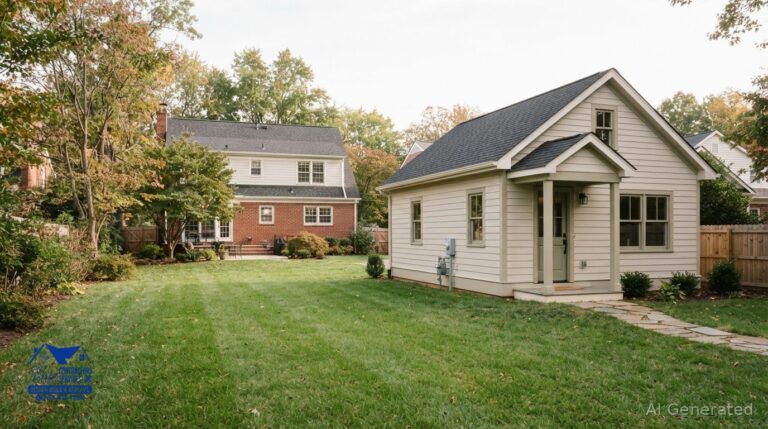
Elite Contractor Services: Accessory Living Unit (ALU) Construction
Elite Contractor Services handles Accessory Living Unit (ALU) construction for homeowners planning a separate living space on their property. When you’re ready to move from general noise-control advice to planning a home project, the team’s Design-Build Services bring design and construction planning together. This makes it possible to consider work sequencing, equipment placement, and practical noise controls as part of the project plan.
For larger changes to an existing home, Whole House Remodeling may also suit your project. The right scope depends on what you want to build and how it relates to your home. Share your goals and concerns about construction noise so they can inform the project discussion.
Contact Elite Contractor Services to discuss your project.
Plan a More Considerate Project
The next step is to turn noise concerns into clear project priorities. Before planning begins, consider which rooms or parts of daily life need the most protection and when disruption would be hardest to manage. That context can guide decisions about sequencing, access, and communication. For homeowners dealing with construction noise during a renovation, a practical plan starts with how the home is used, not just the work schedule.
Bring those priorities into the project conversation early. Describe what matters most, such as keeping a bedroom usable during daytime work or limiting disruption around a home office. Clear expectations give the planning process a specific goal and make it easier to discuss trade-offs as the project scope takes shape.
If you’re considering a home project, contact Elite Contractor Services to talk through your goals and next steps. A thoughtful starting point can help you move forward with greater clarity and confidence.
Frequently Asked Questions
Does construction being within permitted hours mean the noise is automatically acceptable?
No. Work hours and noise limits are separate parts of local requirements, and a project may have to meet both. Identify the activity causing concern, such as demolition or deliveries, then compare its timing and conditions with local rules. A schedule that appears permitted doesn’t establish that every sound or work practice complies.
How do you reduce construction noise in an occupied multifamily building?
Coordinate the work so residents know which areas and routines may be affected. For example, a building manager can notify residents about noisy work near a particular stairwell or unit, while the project team sequences tasks to avoid unnecessary repeat disruption. Barriers, suitable equipment placement, and quieter methods can help. In high-density residential renovations, firms like FT2 Interior Design often emphasize disciplined task sequencing and proactive neighbor communication to keep disruption contained. Residents can also close windows, seal obvious door gaps, and use a quieter room during especially disruptive tasks.
What Are Your Rights When It Comes to Nearby Construction?
Your protections depend on local noise ordinances, permit conditions, and the circumstances of the property. You can document disruptive work, review the local rules, and report suspected violations through the appropriate municipal process. A complaint isn’t proof that a legal limit was exceeded. If nearby construction causes property damage or affects a rental, keep records and address those issues through the relevant property or insurance process.
What time is construction allowed to start in a residential area?
There is no single construction start time for every residential area in the United States. Local ordinances set schedules, and some distinguish weekdays, Saturdays, Sundays, or holidays. Find the rule for the city or county where the work is taking place, then check whether it covers the activity involved. A permitted start time may also come with noise limits or project-specific conditions.
Who should communicate construction noise updates to residents?
The project team or property manager coordinating the work should provide affected residents with clear updates. For example, if a planned demolition task moves to another day, residents need the revised date and expected area of impact. A consistent point of contact helps prevent conflicting messages. Updates should reflect the actual schedule, explain changes plainly, and reach residents before the affected work begins whenever possible.
What hours are construction crews allowed to work in my city?
Your city or county ordinance is the starting point because hours differ by location and may vary by day or type of work. Search the local government’s construction-noise or noise-control information, or contact the appropriate municipal office. Check the full schedule, including weekend and holiday provisions, and review any project permit conditions. Don’t assume a neighboring city follows the same hours.
How do I report construction noise to my local government?
Use the reporting channel specified by your local government, which may direct residents to a municipal office or the police department’s nonemergency line. Provide the construction address, when the noise occurred, and the activity you observed. Explain whether the concern involves work outside allowed hours or disruptive sound during scheduled hours. Follow local reporting instructions, since procedures and responsible departments vary.
What should I include in a construction noise complaint?
Include the project location, dates, start and end times, duration, and type of sound or activity you noticed. Identify equipment if possible, such as a saw, compressor, or jackhammer, and describe how the noise affected your home. Attach a consistent noise log and any recordings, noting how they were made. Share decibel readings as observations, not official compliance measurements.